 Daniel
•
November 5, 2026
•
16 min read
•
No comments
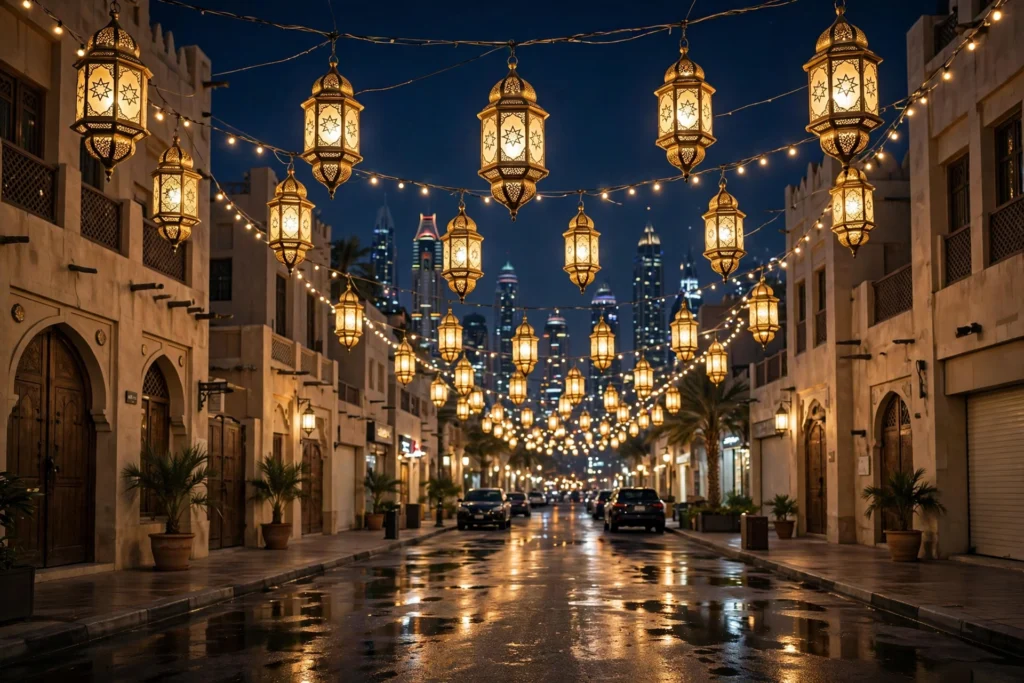
A Ramadan in Dubai trip runs on a different clock from the rest of the year. The city is quiet in the afternoon, then comes alive at sunset when the fast breaks, and stays busy long after midnight. This Ramadan in Dubai guide covers the dates, the daily rhythm, iftar and suhoor, what stays open, the rules for non-Muslim visitors, and what it costs, so you can plan around the month instead of being surprised by it.
Three numbers decide most of a Ramadan in Dubai trip. The holy month is expected to start around Monday 8 February 2027, subject to the official moon sighting, and to last 29 or 30 days. The fast runs about 12 to 13 hours a day in February, from before dawn to around 6pm. And working hours fall by two hours a day across the UAE during the month. Everything else in this guide is a choice between the daytime calm and the evening life that follows it.
Ramadan is the ninth month of the Islamic lunar calendar and the holiest month of the year for Muslims. Capable Muslims fast from dawn to sunset, abstaining from food and drink, and place greater emphasis on prayer, reflection, charity and community. The start and end of the month are set by the official moon-sighting announcement, so no date in this guide is final until the UAE Moon Sighting Committee confirms it.
| What | During Ramadan in Dubai |
|---|---|
| Dates (expected) | Around Monday 8 February to around 8 or 9 March 2027, subject to moon sighting; Eid al-Fitr expected 9 or 10 March 2027 |
| Fasting hours | About 12 to 13 hours a day; suhoor ends around 5.38am at the start, iftar around 6.08pm |
| Non-Muslim visitors | Not required to fast; daytime dining available in malls and hotels |
| Attractions and malls | Open, with adjusted hours; malls commonly stay open late |
| Working hours | Reduced by two hours a day across the UAE |
| Restaurants | Daytime service in malls and hotels; full service from iftar onwards |
| Evenings | The busiest time of day; iftars, markets and late-night dining run past midnight |
| Desert safaris | Still run, but live entertainment, alcohol service and camp programmes may change |
The dates in this Ramadan in Dubai table are astronomical projections, not confirmed dates. The UAE Moon Sighting Committee meets on the evening of Sunday 7 February 2027 to look for the new crescent, and the first fast is expected on Monday 8 February if the moon is sighted. If it is not sighted, every date moves by a day. One listing site gives 7 February as the start; the Emirates Astronomical Society, the UAE Astronomy Centre and Gulf News all give 8 February, which is the date this guide uses.
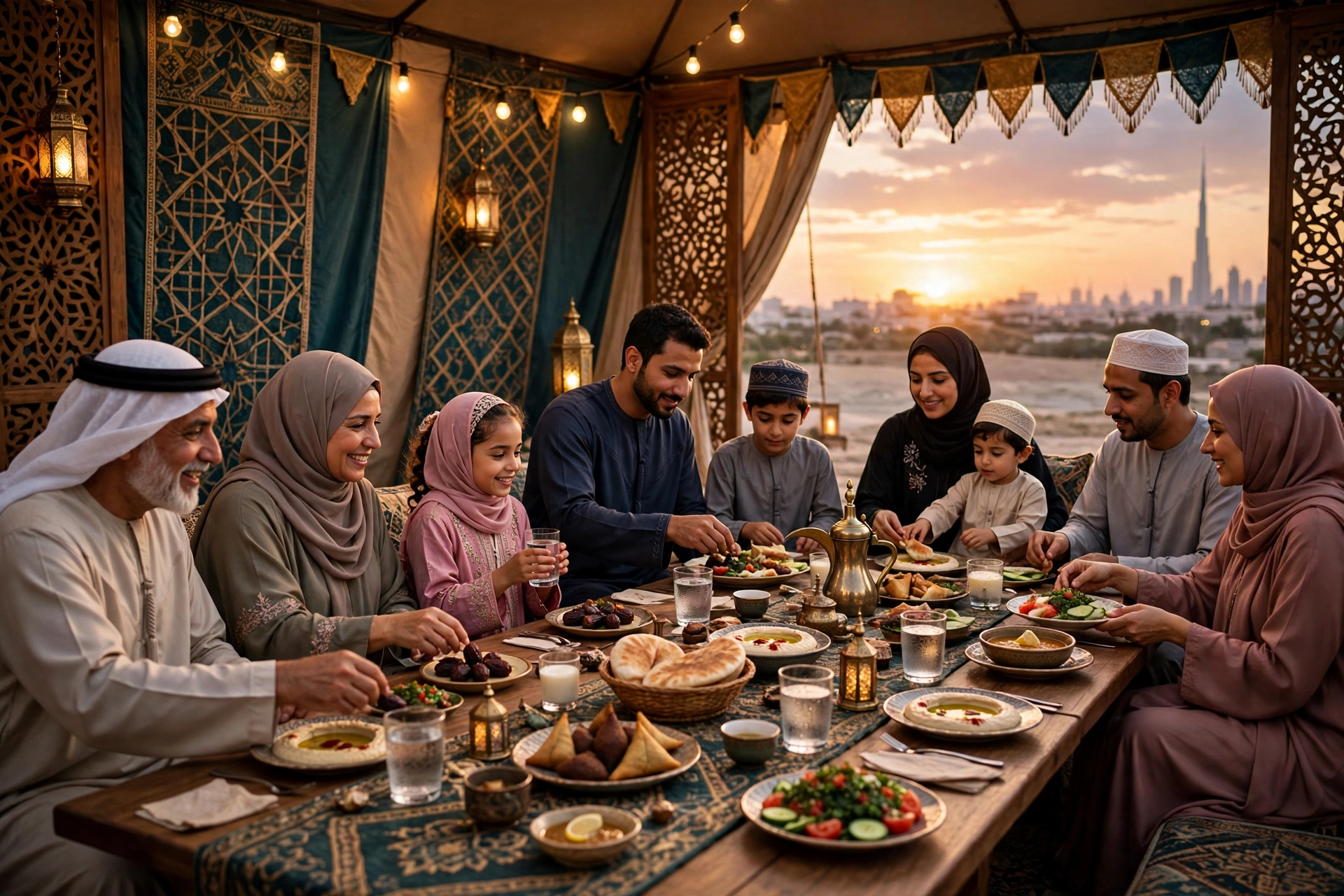
The best way to understand Ramadan in Dubai is to follow one day from before dawn to late at night. The rhythm is the same every day, and it shapes everything from traffic to restaurant queues.
Suhoor is the pre-dawn meal before the fast begins, and in early February it ends around 5.38am, moving to around 5.18am by early March as the days lengthen. Many hotels serve suhoor to guests, and some run late-night suhoor programmes that start soon after iftar and run through the night. If you are staying in a hotel during Ramadan in Dubai, ask at check-in about breakfast and suhoor arrangements rather than relying on times copied from another year, because the exact timing shifts a little every day.
The morning is the quietest part of a Ramadan in Dubai day. Attractions can be pleasant to visit early, especially before the hottest part of the day, and queues are often shorter than in peak season. Supermarkets and grocery shops continue operating, and malls open on their normal daytime schedule. This is the best window for sightseeing that needs daylight, such as the Creek, the souks and the beaches.
The afternoon is when fasting residents conserve energy, and the city slows down. Government and private-sector working hours are reduced by two hours a day under UAE labour rules, so offices and services finish earlier. Schools run shorter days too. Keep your own sightseeing realistic in the afternoon, and use a mall or hotel for a proper break if you are out all day. Some smaller shops run split or adjusted hours, so check the individual venue on the day if a visit matters.
Iftar is the meal that breaks the fast at sunset, and in early February that falls around 6.08pm, moving to around 6.24pm by early March. The fast is traditionally broken with dates and a drink before the larger meal, and a cannon is fired at sunset to mark the moment, followed by the call to prayer from the mosques. Around sunset, transport demand shifts fast as people travel to join family, friends and colleagues, and taxis can be harder to find while drivers break their fast, so leave extra time for any fixed reservation.
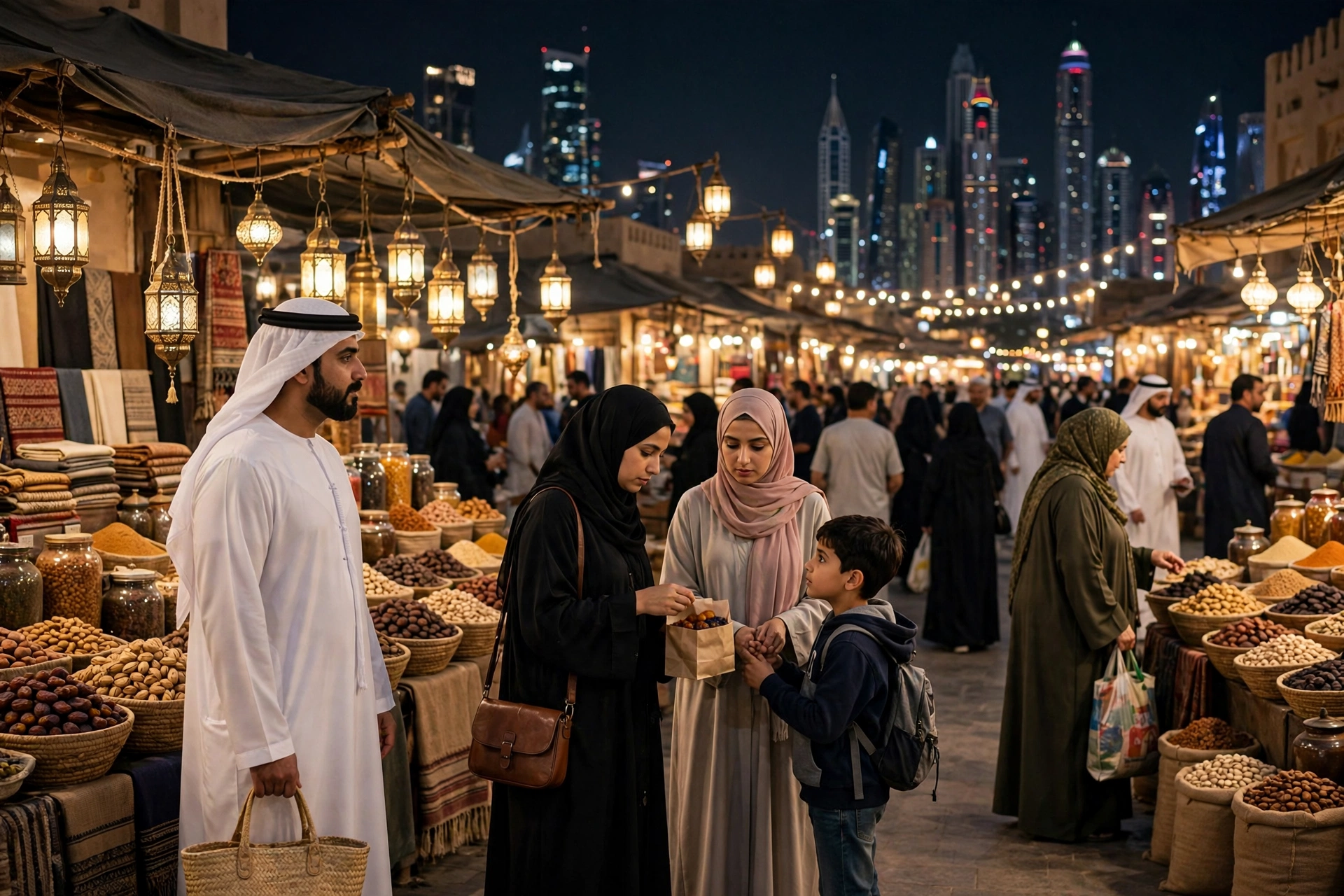
After iftar, Dubai becomes much busier. Families shop, dine and visit well into the evening, restaurants serve iftar and suhoor menus, and malls stay open late. Ramadan markets, night markets and seasonal events run into the evening, and popular districts become more animated after dark than they are in the afternoon. This is the best time for visitors who want the social side of Ramadan in Dubai rather than merely working around it. If you usually start sightseeing at 8am and sleep early, consider shifting your schedule: a later morning, a relaxed afternoon and a long evening fit the month better.
Iftar is one of the most memorable Ramadan experiences available to visitors, and non-Muslims are welcome at many restaurant and hotel iftars. For Muslim families it is first a religious and communal moment, not merely a themed dinner, so arrive on time, follow the host venue’s guidance, and be patient in the minutes around sunset.
There are four ways to break the fast in Dubai. A hotel buffet is the easiest for a first-time visitor, often large and polished, with Emirati and regional dishes alongside international food. An Emirati or regional restaurant is the better option if the food itself matters more than spectacle. A community or cultural programme, such as the cultural meals run by the Sheikh Mohammed Centre for Cultural Understanding in Al Fahidi, can be the most meaningful, but follow the organiser’s participation and dress guidance. A small dinner with residents, if you are genuinely invited, can be more memorable than any commercial package.
The big Ramadan tents are the centrepiece of the month. Asateer at Atlantis The Palm is the largest and best known, holding over 1,000 guests, with themed buffet nights and live cooking stations. Al Majlis at Madinat Jumeirah is the longest-running major tent in the city, set inside the Madinat Arena. Laylati at Grand Hyatt Dubai is the big tent of Old Dubai, with an Andalusian theme. These venues return every Ramadan, but their 2027 prices and menus are not announced yet. The prices below are from last Ramadan, in 2026, and are planning figures only, not 2027 prices.
Suhoor is the meal before dawn, but in Dubai the word also covers late-night hotel and restaurant programmes. After iftar, many hotels and restaurants keep serving through the night, and the suhoor programmes are where the city socialises after midnight. Some venues serve a full buffet, others an a la carte menu, and a few run shisha lounges alongside the food.
For a visitor, the practical point is simple: if you are not fasting, the late-night suhoor scene is the easiest way to eat well after dark without booking a formal iftar. Prices are usually lower than the big iftar buffets, and the atmosphere is more relaxed. Ask your hotel what it runs, because the programmes change every year and are announced close to the month.
The UAE Government states that amusement parks, restaurants, cultural sites and tourist attractions remain open through the day during Ramadan in Dubai. The important variable is hours: an attraction may adjust its schedule, last entry or entertainment programme for the month.
Malls commonly stay open late, and supermarkets and grocery shops continue operating. Some smaller businesses run split or adjusted hours. Government services, banks and specialist businesses may also adjust their hours, so verify directly rather than assuming one Ramadan schedule covers everything.
Desert safaris still run during Ramadan in Dubai, but check the operator’s current Ramadan notes before booking. Live entertainment, alcohol service and camp programming may change during the month, and the standard-season product is not always identical. The same applies to beach clubs and boat trips: most keep running, but hours and entertainment can shift.
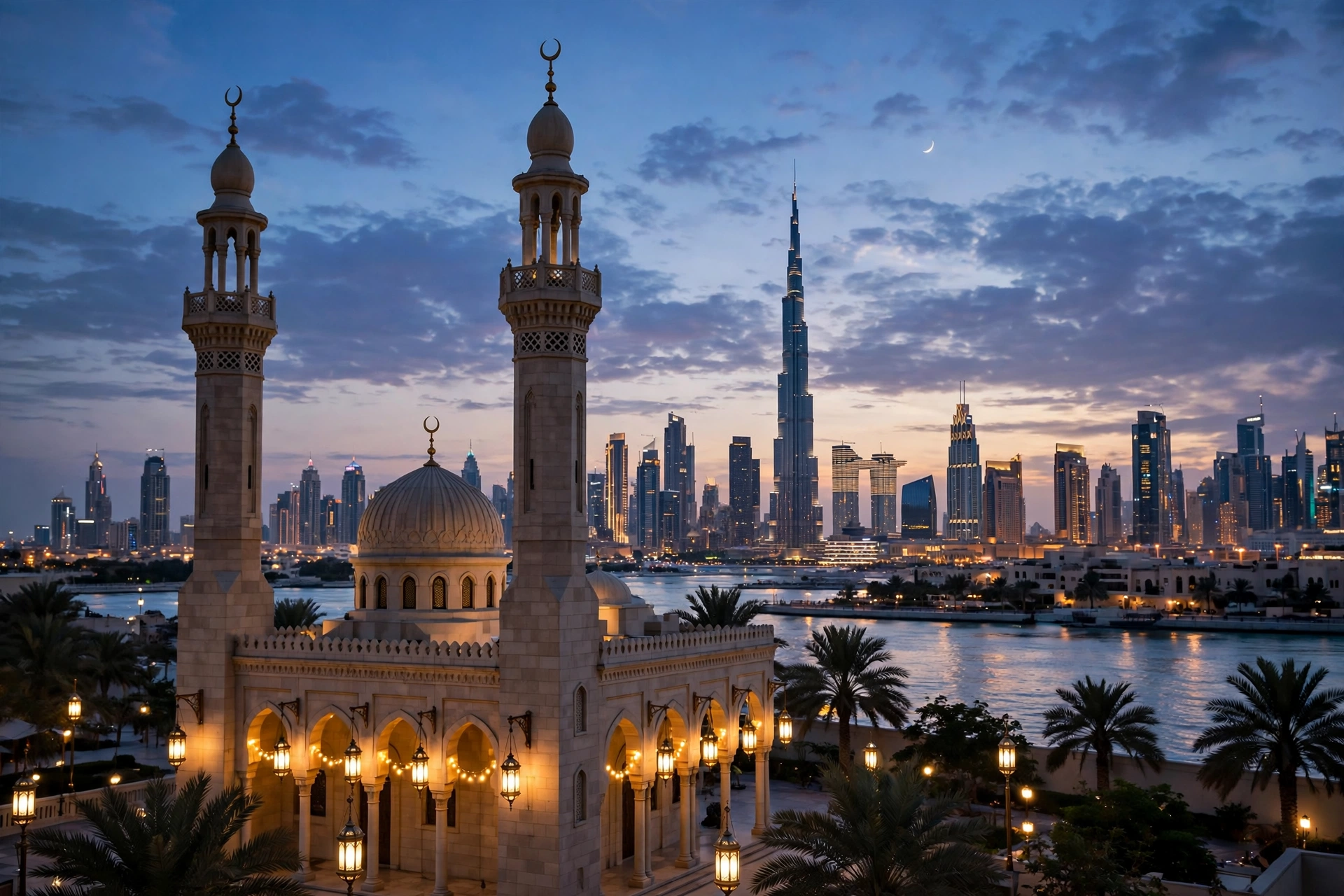
February is also a comfortable month for the outdoors. February daytime highs average around 26 degrees and night lows around 16 degrees, so the beaches, the Creek and the desert all work well in the middle of the day. Global Village and Miracle Garden are in full season through February and into March, and both are evening attractions, which suits the Ramadan rhythm.
Ramadan in Dubai should not be sold as automatically cheaper or less crowded. Demand varies by year, school holidays, events and travel markets, so price your actual dates instead of assuming a Ramadan discount. Hotel rates in February are peak-season rates, and the second half of February costs more than the first in most years.
Iftar is the main cost to plan for. The 2027 prices are not announced yet, so the table below gives last Ramadan’s prices as planning figures, with the venue and the year stated so you can check the current price before you book.
| Iftar type | Price per person (Ramadan 2026, planning figure) | Notes |
|---|---|---|
| Budget restaurant iftar | From AED 49 | Set menus at casual restaurants; Al Safadi and Operation Falafel were among the cheapest in 2026 |
| Mid-range hotel buffet | AED 150 to AED 250 | Most hotel buffets; Laylati at Grand Hyatt was AED 249 for adults and AED 150 for children in 2026 |
| Large Ramadan tent | AED 295 to AED 350 | Asateer at Atlantis was AED 295 Monday to Thursday and AED 325 Friday to Sunday in 2026; Al Majlis at Madinat Jumeirah was AED 350 |
| Luxury tent or desert iftar | AED 350 to AED 490 | Premium venues and desert experiences; a desert iftar in the conservation reserve was AED 490 in 2026 |
| Suhoor programme | Often lower than iftar | Late-night hotel programmes; Asateer suhoor was AED 160 without shisha and AED 250 with shisha in 2026 |
Three costs catch first-time visitors out during Ramadan in Dubai. The first is the iftar booking itself: the popular tents sell out, especially on weekends, so book days ahead and confirm the price, because 2027 prices may differ from the 2026 figures above. The second is the taxi bill around sunset, when demand peaks and drivers break their fast; a taxi from Downtown to the Marina costs around AED 40 to AED 60 at normal times, and the wait can be longer at iftar. The third is the hotel: February is peak season, so the room is the biggest single line in the budget, and the second half of the month costs more than the first.
Non-Muslims are not required to fast, and Dubai remains open to tourism during Ramadan in Dubai. The rules that matter most are simple and practical, and they are about respect rather than imitation.
Eating and drinking during the day is available to visitors. UAE Government guidance says non-Muslims can find daytime dining in shopping malls, with restaurants and food courts providing designated areas away from people who are fasting, and hotels commonly maintain food service for guests. Older travel advice often says daytime eating is impossible in Dubai; that is no longer a useful description. In 2024 the rules changed so that eating or drinking in public during fasting hours is no longer a criminal offence, and restaurants no longer need to cover their dining areas. The respectful approach is still to use the venues that are operating for daytime service rather than eating or drinking openly in front of people who are fasting, and to keep it discreet in public places.
Dress a little more conservatively than usual in public during Ramadan in Dubai, especially around mosques, cultural sites and community events. Dubai remains a cosmopolitan tourism city, and visitors are not expected to imitate religious observance they do not follow, but shoulders and knees covered is a sensible default away from the beach and the pool. If you visit a mosque or a religious programme, follow that venue’s dress and access rules. The Jumeirah Mosque tours run Saturday to Thursday at 10am and 2pm, about 75 minutes, with registration 30 minutes before, and Friday is closed; women cover arms, legs and hair, and abayas are provided.
Keep public behaviour considerate. Avoid loud music or boisterous conduct around people marking the month, and keep public displays of affection low-key. Be cautious with old internet lists claiming dozens of Ramadan-specific legal prohibitions; rules and operating practices evolve, and for anything with legal consequences, rely on current UAE and Dubai government guidance rather than a travel blog’s recycled checklist. “Ramadan Kareem” and “Ramadan Mubarak” are widely used greetings and are appropriate to receive or offer warmly.
Ramadan in Dubai is a good time to visit for the right traveller, and a frustrating one for the wrong one. It suits you if you want cultural context rather than only attractions and resorts, enjoy late dinners and lively evenings, are comfortable checking opening hours rather than following a rigid itinerary, and want to experience iftar, Ramadan markets and a more community-focused side of Dubai.
You may prefer another month if you want nightlife and entertainment to operate exactly as in the rest of the year, need every restaurant and activity to keep standard hours, prefer very early starts and quiet evenings, or are unwilling to adapt around a culturally important month. The city does not close during Ramadan in Dubai, but it does change its rhythm, and the trip works best when you change yours to match it.
For the rest of the planning, see our Dubai travel guide for visas, transport and money basics, and our Dubai itinerary 3 days for a day-by-day shape you can shift into the evening. For the food itself, our Emirati food Dubai guide covers the dishes you will meet at iftar, from harees and machboos to luqaimat, and our Jumeirah Mosque Dubai guide covers the mosque visit in full.
Ramadan in Dubai is expected to start around Monday 8 February 2027 and last 29 or 30 days, ending around 8 or 9 March, with Eid al-Fitr expected on 9 or 10 March. Every date is subject to the official moon sighting: the UAE Moon Sighting Committee meets on the evening of Sunday 7 February, and if the crescent is not sighted, all dates move by a day. Check the official announcement close to travel.
No. Non-Muslims are not required to fast during Ramadan in Dubai. Daytime dining is available in shopping malls, with restaurants and food courts providing designated areas, and hotels commonly maintain food service for guests. Use the venues that are operating for daytime service, and keep eating and drinking discreet in public places out of respect for people who are fasting.
Yes. Non-Muslims are welcome at many restaurant and hotel iftars during Ramadan in Dubai, and no one will ask about your faith at the door. Book ahead, especially for the big tents and for weekends, arrive on time, and follow the venue’s guidance around sunset. A hotel buffet is the easiest first iftar; an Emirati restaurant or a cultural programme in Al Fahidi is the more meaningful one if the food and the setting matter more than scale.
Most things stay open during Ramadan in Dubai. Malls, attractions, amusement parks, cultural sites and restaurants all continue operating, though hours adjust and malls commonly stay open late. Some smaller shops run split hours, and desert safaris may change their entertainment and alcohol service. Check the individual venue on the day, especially for timed entries and evening programmes.
Dress a little more conservatively than usual in public during Ramadan in Dubai, especially around mosques, cultural sites and community events. Shoulders and knees covered is a sensible default away from the beach and the pool. Swimwear is fine at the beach and the hotel pool. Mosques have their own dress rules: at Jumeirah Mosque, women cover arms, legs and hair, and abayas are provided.
Not automatically. Ramadan in Dubai should not be sold as a guaranteed discount: hotel rates in February are peak-season rates, and demand varies by year and by travel market. Some hotels and restaurants run Ramadan offers, and the big iftar buffets are a fixed cost rather than a saving. Price your actual dates, book the hotel early, and treat any Ramadan offer as a bonus rather than the reason to travel.
Iftar in Dubai falls at sunset, which is around 6.08pm at the start of Ramadan in Dubai in early February 2027 and around 6.24pm by early March, according to projected prayer timetables. Suhoor ends around 5.38am at the start and around 5.18am by the end. These are projections, not the official timetable, so check the daily prayer times on the day you travel.
This is a researched guide to Ramadan in Dubai, not a first-hand trip report. Facts were checked on 5 November 2026 against official pages and current listings. The expected Ramadan 2027 dates come from the Emirates Astronomical Society and the UAE Astronomy Centre, reported by Gulf News, with the moon-sighting caveat stated throughout. Daytime dining, attractions and working-hour rules follow UAE Government guidance as summarised by Visit Dubai and by Totally Dubai, reviewed 30 August 2026. Iftar prices are from Ramadan 2026 listings and are labelled as planning figures, not 2027 prices. Visit Dubai’s official Ramadan page is at Visit Dubai Ramadan, and the Sheikh Mohammed Centre for Cultural Understanding is at SMCCU. Prayer timings are projected timetables for February and March 2027. Prices and hours change often, so confirm with the venue on the day you go.
Written by
Daniel
Daniel is the travel writer behind Go Dubai Now, covering Dubai's attractions, parks, restaurants and practical travel topics. Every guide is researched against official sources — government portals, operator websites and current local listings — and updated regularly so timings, prices and rules stay accurate. His goal is simple: answer the exact questions travelers ask before they go, with no fluff and no outdated information.
Handpicked guides, itineraries and money-saving tips for your Dubai holiday — all in one place.