 Daniel
•
November 11, 2026
•
16 min read
•
No comments
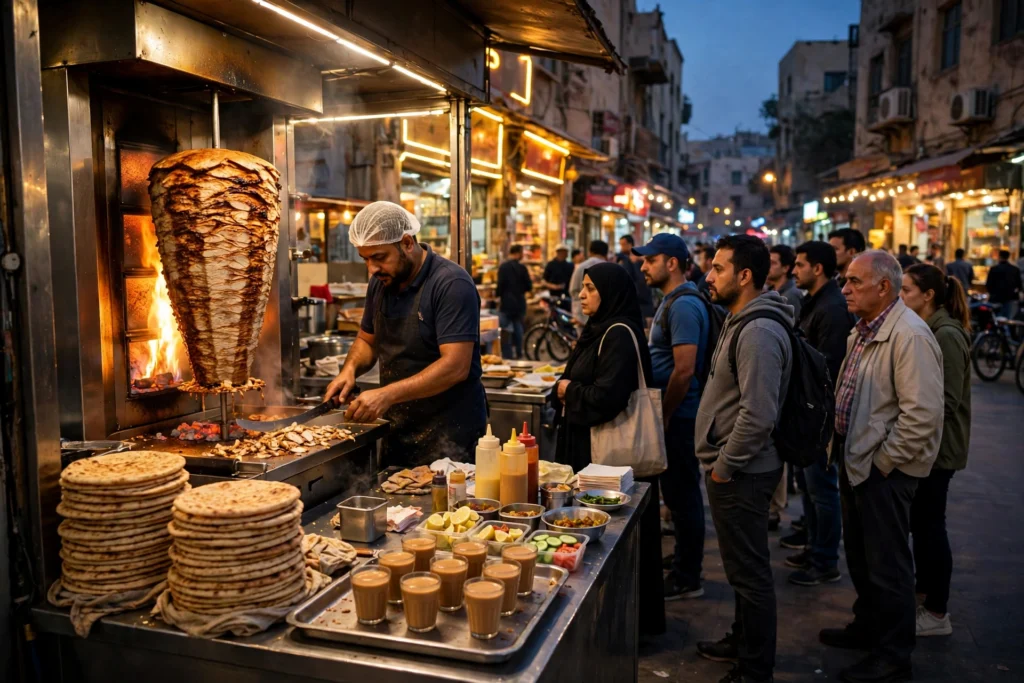
Dubai street food is the cheapest honest meal in the city. Most dishes cost AED 5 to AED 15, a cup of karak chai costs AED 2 to AED 5, and a full evening of grazing across three or four stops in Karama rarely passes AED 50 per person. This guide lists the 10 dishes to try first, the five areas where the food is best, and the prices to expect at the counter.
Dubai street food is not one cuisine. It is Levantine shawarma and manakish, South Asian chaat and parathas, Emirati luqaimat and rigag, and Persian kebabs, all cooked side by side in the older districts of the city. Most Dubai street food is sold from small cafeterias and bakeries rather than from carts on the pavement, so the word cafeteria on a sign is your best clue that cheap, fast food is inside. If you are planning a first trip, read our Dubai travel guide first, then use this page to plan where to eat.
Dubai street food means food cooked fast, sold cheap, and eaten without ceremony. You order at a counter, you pay, and you eat standing up, on a plastic stool, or in your car. The kitchens are small and the menus are short, which is why the quality stays high. A shop that sells only shawarma and manakish has to get both right, every day, or the shop next door takes its customers.
Dubai street food reflects who lives in Dubai. About nine in ten residents are expatriates, so the street food of Dubai carries flavours from Lebanon, Syria, Palestine, Iran, India, Pakistan, the Philippines and the Emirates themselves. That mix is the point. In one evening in Karama you can eat a Lebanese shawarma, an Indian pani puri and an Emirati luqaimat within a few minutes of each other, and none of it will feel like a tourist performance.
Most Dubai street food is halal. Dubai regulates its food trade tightly, and the cafeterias and bakeries in the old districts serve halal meat as standard. If you eat pork or drink alcohol, you will find those only in licensed hotel venues, not at a street food counter. Vegetarian food is easy to find too, and the vegetarian section below lists the safest picks.
Start with these ten Dubai street food dishes. They cover every part of the city map below, and together they cost less than one hotel breakfast.
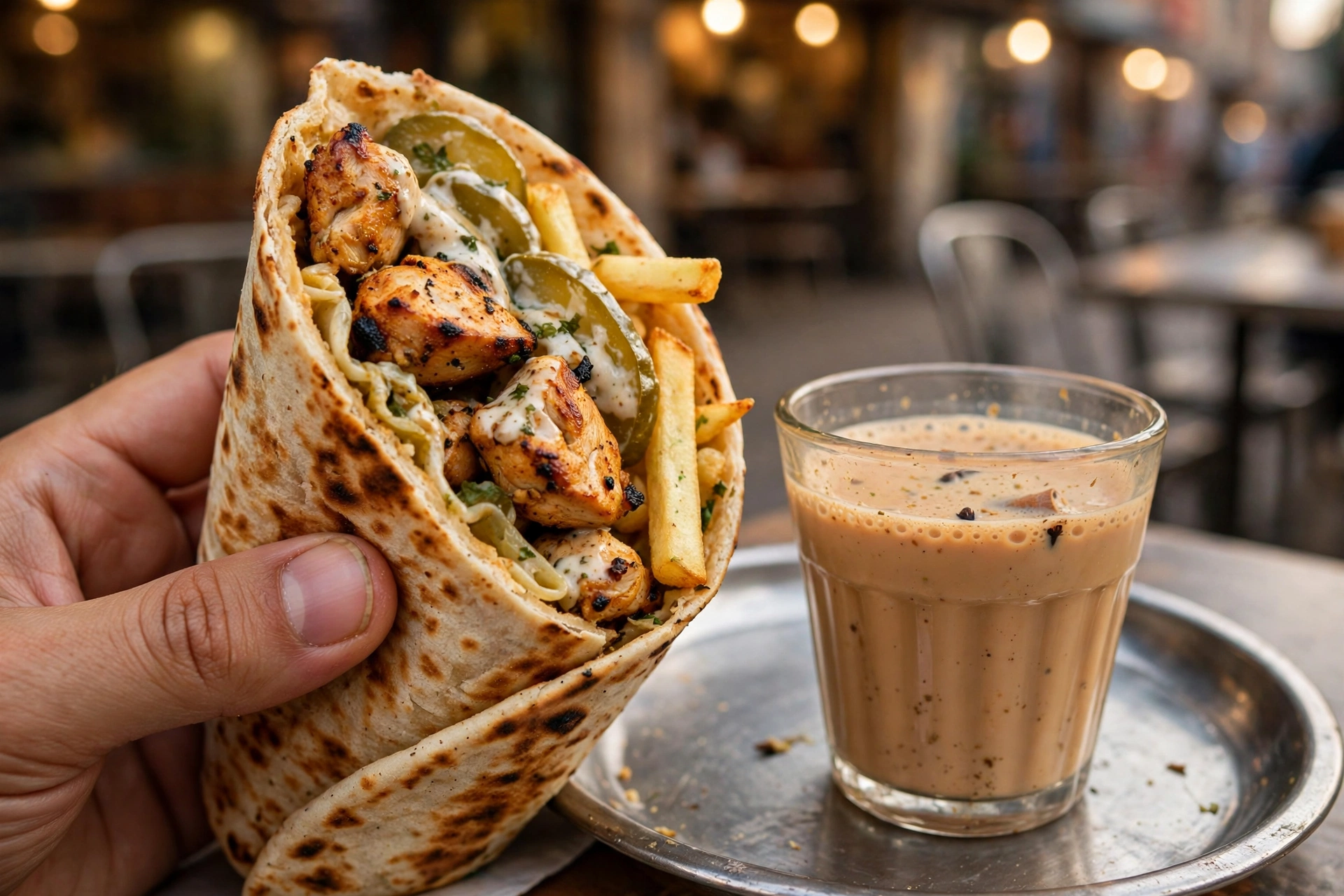
Shawarma is the first dish of Dubai street food, and the one every visitor should try on day one. Chicken or lamb turns slowly on a vertical spit, is shaved to order, and is rolled into flatbread with garlic sauce, pickles and sometimes fries. A chicken shawarma usually costs AED 5 to AED 12. The best Dubai street food shawarma comes from shops with a single spit and a queue outside. In Satwa, Al Mallah on 2nd December Street is the long-running reference point, and its chicken shawarma is widely quoted at AED 10.
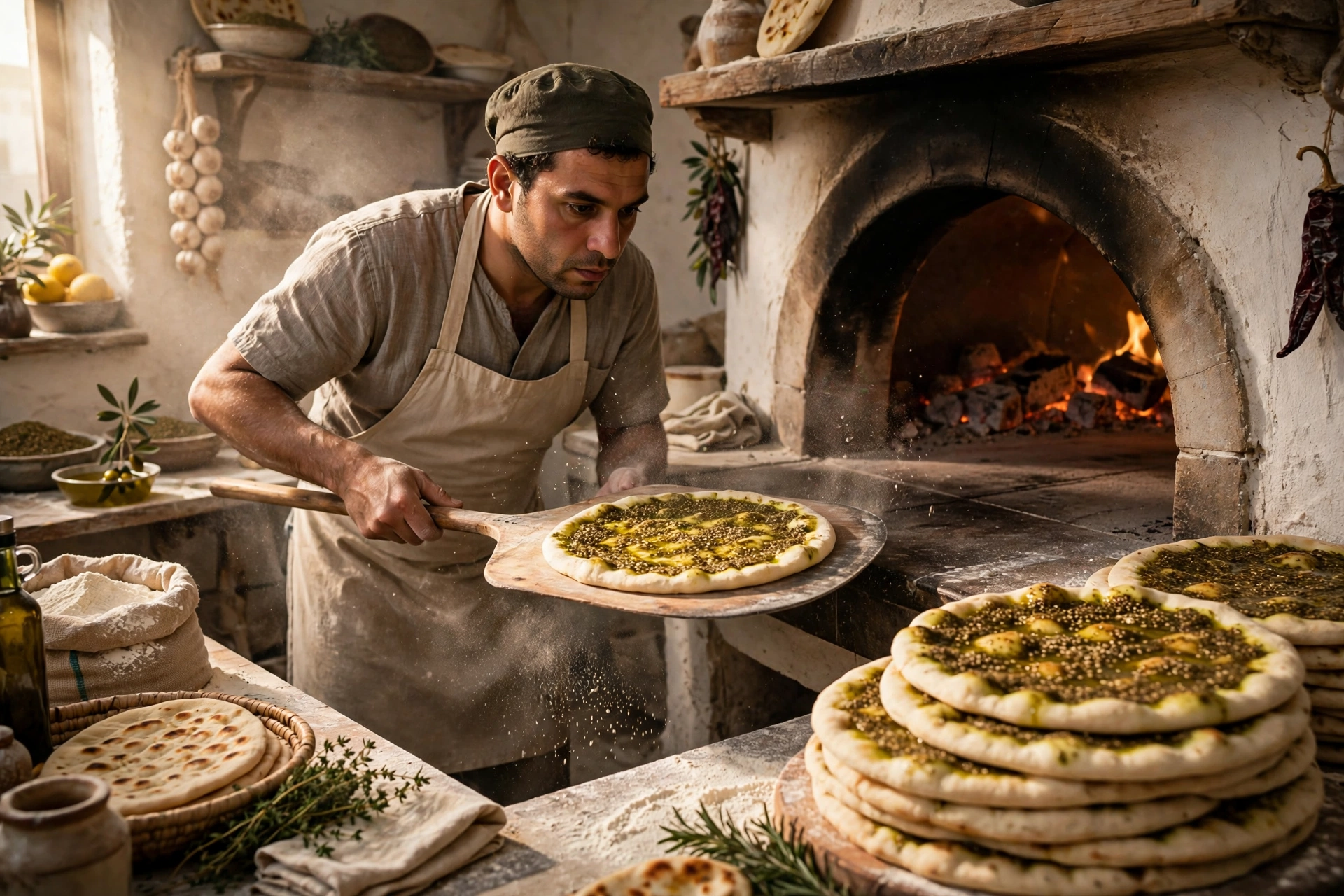
Manakish is a soft flatbread baked to order in a stone oven, topped with zaatar and olive oil, white cheese, or spiced minced meat. It is the breakfast half of Dubai wakes up to, and a zaatar manakish usually costs AED 5 to AED 10. Eat it hot and rolled, straight from the oven. The cheese version costs a little more, usually AED 8 to AED 15.
Karak chai is strong black tea boiled with cardamom, ginger and other spices, then finished with evaporated or condensed milk until it turns sweet and caramel coloured. It costs AED 2 to AED 5 a cup, which makes it the cheapest real Dubai experience there is. Cafeterias sell it all day, and the late-night karak shops of Deira and Satwa stay busy long after midnight. FiLLi Cafe, with branches across the city including Kite Beach, is the best-known karak chain if you want a first cup with somewhere to sit.
Falafel in Dubai is freshly fried, green inside from the herbs, and served in flatbread with tahini, pickles and tomato, or on a plate with hummus. A falafel wrap usually costs AED 5 to AED 10. It is the most reliable cheap vegetarian meal in the city, and the Levantine shops of Karama and Satwa fry it to order rather than holding it under a lamp.
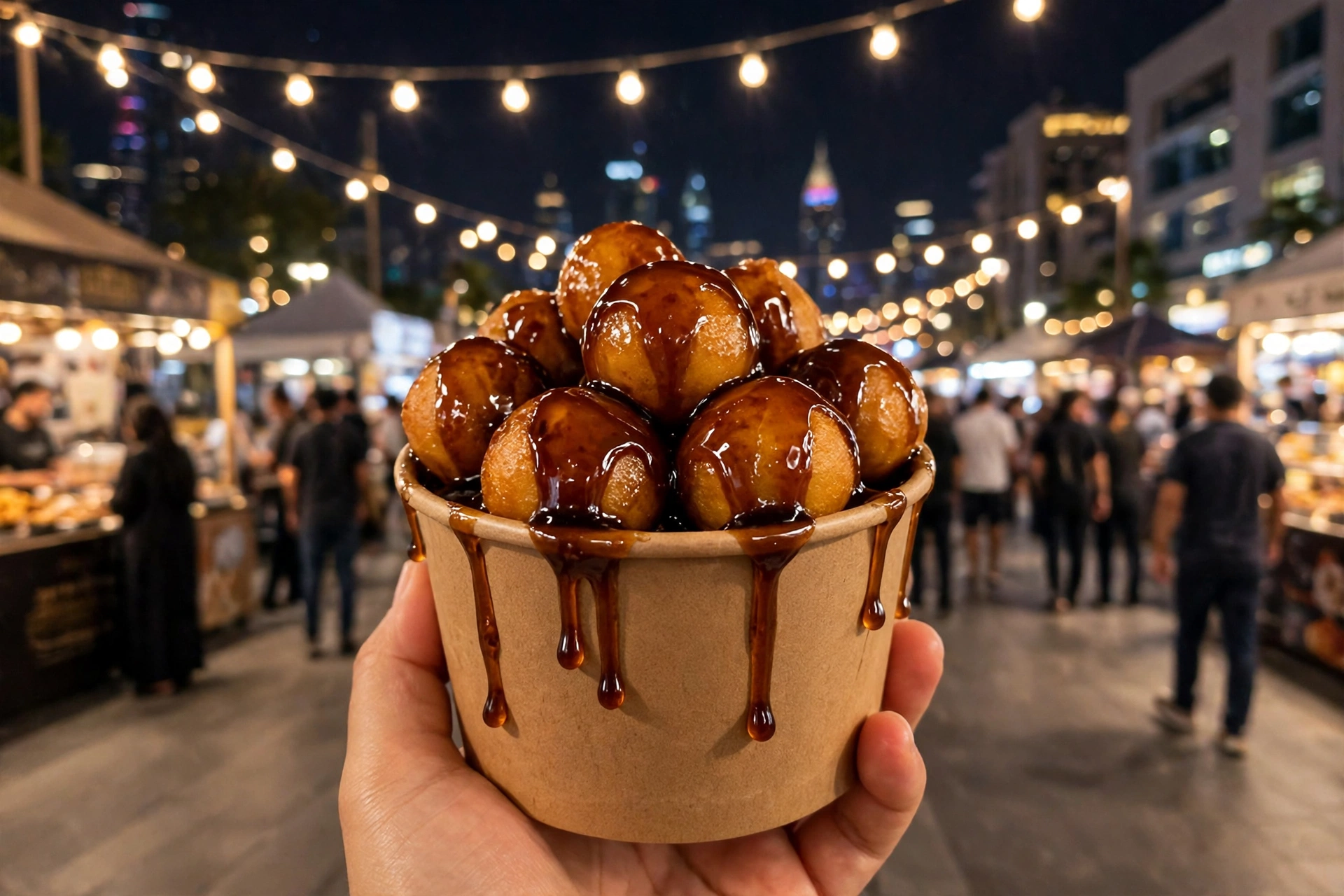
Luqaimat are crisp fried dough balls drizzled with date syrup and sometimes sesame seeds. They are an Emirati sweet, a Ramadan staple, and a year-round favourite at souqs and festivals. A portion of six usually costs AED 8 to AED 20. Eat them hot, within minutes, because they soften fast. The stalls at Al Seef along Dubai Creek and the food courts of Global Village are good places to try them for the first time.
Samboosa is the Gulf cousin of the samosa, a crisp fried triangle filled with spiced meat, cheese or vegetables. Three pieces usually cost AED 5 to AED 12. They are everywhere during Ramadan, when they are a standard part of iftar, and they are sold year-round at South Asian stalls in Deira and Karama.
Knafeh is a sugar-syrup soaked pastry filled with hot, soft cheese and topped with crushed pistachios. It is sweet, salty and warm at the same time, and it is best eaten fresh from the tray, not reheated. Look for it at Levantine sweet shops in Deira and Karama, and ask for the Nabulsi version if you want the classic cheese filling.
Kebabs in Dubai street food cover Persian, Turkish, Lebanese and Pakistani styles, so one word covers very different plates. The safest first order is a chicken tikka or a seekh kebab with flatbread and salad, usually AED 15 to AED 40 as a plate. Al Ustad Special Kebab in Bur Dubai has served Iranian kebabs since 1978, and its saffron chicken kebab is the order regulars come back for. Ravi Restaurant in Satwa, also open since 1978, is the Pakistani counterpart, and its chicken tikka and mutton karahi are the dishes to ask for.
Chaat is the South Asian answer to Dubai street food, and Karama and Meena Bazaar are where it lives. Pani puri are crisp shells filled with spiced potato and dunked in tangy spiced water. Bhel puri, chana chaat and vada pav sit on the same menus. Expect AED 10 to AED 25 a plate. If you are new to it, start with bhel puri, which is crunchy and tangy without much heat, and ask for the spicy water on the side with pani puri.
Rigag is the Emirati street snack most visitors miss. Paper-thin rigag bread is cooked like a crepe on a hot round pan, then topped with egg, cheese, honey, or the local favourite of crushed Chips Oman crisps with cheese and hot sauce. It is made to order in small grocery shops and heritage cafes, including around Jumeirah and Al Seef. A rigag usually costs AED 5 to AED 15. For the fuller Emirati table behind it, read our Emirati food guide.
The best Dubai street food sits in five areas. Pick one area per evening and eat your way along it, rather than crossing the city between single dishes.
Karama is the first area to visit for Dubai street food. The streets around Kuwait Street and Sheikh Hamdan Colony are packed with shawarma shops, manakish bakeries, falafel counters, chaat stalls and karak shops, all competing for the same customers. Prices stay low and quality stays high because of that competition. A full grazing meal across three stops costs about AED 25 to AED 50 per person. Karama is served by ADCB station on the Red Line. Read our Karama guide for the area itself, and our Indian restaurants guide if you want sit-down meals after the stalls.
Deira is where Dubai street food comes alive after dark. The streets around Naif, Al Rigga and the Gold Souk backstreets hold samboosa specialists, Iranian kebab houses, karak shops that never seem to close, and juice bars. Many stalls run until 2am or later. Deira is served by Union and Baniyas Square stations on the Green Line, and the abra across Dubai Creek from Bur Dubai costs AED 1 per person, which is the cheapest crossing in the city.
2nd December Street in Satwa, still known to many as Al Dhiyafah Road, is a single street that works as a food crawl on its own. Lebanese grills, Iranian kebab houses, Pakistani canteens and Filipino eateries sit side by side. This is where Ravi Restaurant and Al Mallah both stand, a few minutes apart, which is why one evening here can cover two of the most famous cheap meals in Dubai. Our Pakistani restaurants guide covers the sit-down side of the same street.
Bur Dubai, around Meena Bazaar and the streets near Al Fahidi, is the oldest street food quarter in the city. Expect South Asian snacks, falooda and juice shops, Iranian kebabs at Al Ustad, and manakish ovens that have run for decades. The area suits a slow evening walk, and it pairs well with the heritage streets of Al Fahidi, which are a short walk from the food stalls.
Al Seef, on Dubai Creek, is the easiest first stop for visitors who want Emirati snacks with a view. Its stalls sell luqaimat, rigag, karak and grilled meats along a heritage-style promenade. At the other end of the city, the food trucks at Kite Beach serve shawarma, sliders and juices at beach prices, which run higher than Karama, usually AED 40 to AED 90 per person. Read our best beaches guide before you plan a beach food stop. Global Village, open in the cooler months, is the seasonal version of the same idea at full scale, and it is covered in the festivals section below.
The Dubai street food prices below are planning ranges, not menu prices. They were gathered from Dubai food guides checked on 11 November 2026, and they include 5 percent VAT where the shop charges it. Menus change, and a mall branch will cost more than the same dish in Karama, so confirm the price at the counter before you order.
| Dish | What you get | Planning range |
|---|---|---|
| Karak chai | Small cup, spiced milky tea | AED 2-5 |
| Manakish zaatar | Flatbread, zaatar and olive oil | AED 5-10 |
| Falafel wrap | Flatbread, falafel, tahini, pickles | AED 5-10 |
| Chicken shawarma | Flatbread wrap, garlic sauce, pickles | AED 5-12 |
| Samboosa, 3 pieces | Fried pastry, meat, cheese or vegetable | AED 5-12 |
| Luqaimat, 6 pieces | Fried dough balls, date syrup | AED 8-20 |
| Meat shawarma | Lamb or beef wrap, tahini | AED 8-18 |
| Chaat plate | Pani puri, bhel puri or chana chaat | AED 10-25 |
| Kebab plate | Skewers, flatbread, salad | AED 15-40 |
| Full grazing evening | Three or four stops, Karama or Deira | AED 25-50 per person |
Cash still matters. Many older cafeterias in Karama, Deira and Satwa prefer cash, and some take cash only, so carry small notes in AED 5, AED 10 and AED 20 denominations. Newer chains and mall branches take cards. A Silver Nol card costs AED 25 including AED 19 of travel credit, and a Metro ride costs AED 3 to AED 7.50 depending on zones, so a food crawl by Metro adds very little to the evening. Check current fares on the RTA Nol fares page before you travel.
Most guides list dishes and areas. Few give you a timed plan, so here is one. It runs on a weekday evening, uses the Metro, and keeps the whole night under AED 50 per person before transport.
Stop one, 7pm: a zaatar or cheese manakish from a Kuwait Street bakery, hot from the oven, with a karak chai. Budget AED 10 to AED 15 and 15 minutes. Stop two, 7.30pm: a chicken shawarma and a falafel wrap from two neighbouring counters, shared between two people so you can compare both. Budget AED 15 to AED 20 and 20 minutes. Stop three, 8.15pm: luqaimat from the busiest stall you can find, eaten while you walk, then a final karak. Budget AED 10 to AED 15 and 15 minutes.
Three rules make the plan work. First, go on a weekday, when the queues are shorter and the ovens are less rushed. Second, follow the queue, not the signboard: the busiest counter in a street of ten identical counters is busy for a reason. Third, check the last Metro time in the RTA S hail app before you set out, because trains run to around midnight on most nights and to 1am on Fridays, and a missed last train turns a cheap evening into a taxi fare.
Ordering Dubai street food is simple once you know the four habits that regulars use. First, say the spice level before you pay, because South Asian stalls cook hot by default. Ask for mild, medium or extra spicy, and ask for sauces on the side if you are unsure. Second, order one dish at a time and share it, because portions are generous and you will want room for the next stop. Third, point at what the person ahead of you is eating if the menu is in Arabic or the names are unfamiliar, because it works and nobody minds. Fourth, keep your order short. A shawarma shop does not need a story, it needs a meat, a bread and a sauce.
For vegetarians, the safe core is manakish with zaatar or cheese, falafel wraps, hummus and cold mezze, vegetable samboosa, and most chaat. Ask whether the bread was cooked on the same surface as meat if that matters to you, because small kitchens share grills. For vegans, falafel wraps without sauce, zaatar manakish without cheese, and hummus with bread are the easiest orders, but always confirm the bread and the sauce, because some flatbreads are brushed with butter or ghee.
On hygiene, use the same test in every city: a busy stall with high turnover and food cooked in front of you is safer than a quiet one with food sitting out. Skip anything that has been sitting uncovered for a long time, drink bottled water, and wash your hands before you eat, because most counters have no sink at the table.
Ramadan changes Dubai street food for the better. The Ramadan Street Food Festival in Karama runs each year during the holy month at Sheikh Hamdan Colony, with stalls opening from iftar at sunset until around 2am, free entry, and dishes from AED 5. The 2026 edition ran from 19 February to 18 March 2026, with more than 70 food outlets across two areas, Flavour Lane and Culinary Crossroads. Dates for the next edition are not announced yet, so check the Visit Dubai events calendar closer to Ramadan before you plan around it.
Global Village is the other seasonal date to plan around. Season 31 opened on 14 October 2026 and runs until May 2027, with entry at AED 25 for a weekday ticket and AED 30 for an any-day ticket, both including 5 percent VAT. It opens at 4pm daily, closes at midnight from Sunday to Wednesday and at 1am from Thursday to Saturday. Its Dubai street food avenue covers dozens of countries in one walk, from Turkish kumpir to Thai mango sticky rice. Check dates and ticket prices on the Global Village official site before you go, because the closing date is announced during the season.
Outside those two seasons, the food does not stop. Karama, Deira and Satwa serve the same dishes all year, and the cooler months from October to April are simply the pleasant time to eat outside. In summer, eat indoors or eat late, after sunset, when the streets fill again.
Karama is the best single area for Dubai street food, because it packs shawarma shops, manakish bakeries, falafel counters, chaat stalls and karak shops into a few walkable streets, and prices stay low through competition. Deira is the best area after dark, when its stalls run until 2am or later. If you only have one evening, spend it in Karama, and save Deira for a second night.
Most Dubai street food dishes cost AED 5 to AED 15. A karak chai costs AED 2 to AED 5, a chicken shawarma costs AED 5 to AED 12, and a manakish costs AED 5 to AED 10. A full grazing evening across three or four stops in Karama costs about AED 25 to AED 50 per person. Beach and mall branches cost more, usually AED 40 to AED 90 per person.
Dubai street food is generally safe to eat when you pick busy stalls with high turnover and food cooked in front of you. Dubai regulates its food trade, and the cafeterias in the old districts are inspected like any other restaurant. Choose the crowded counter, eat food that is cooked to order, skip anything sitting uncovered, and drink bottled water.
Yes, the street food in the old districts of Dubai is halal as standard. The cafeterias and bakeries in Karama, Deira, Satwa and Bur Dubai serve halal meat, and pork and alcohol are confined to licensed hotel venues. If you have a specific dietary rule beyond halal, ask at the counter, because small kitchens share grills and fryers.
Karak chai is strong black tea boiled with cardamom, ginger and other spices, then finished with evaporated or condensed milk until it is sweet and caramel coloured. It costs AED 2 to AED 5 a cup and is sold at cafeterias across the city. Try your first cup at a busy cafeteria in Karama or Satwa, or at a FiLLi Cafe branch, and order it small, because it is stronger and sweeter than most visitors expect.
The best time to try Dubai street food is between October and April, when the evenings are cool enough to eat outside. Within a day, the best windows are breakfast, from 7am to 9am for fresh manakish, and the evening, from 7pm to 11pm, when the stalls are busiest and the food is freshest. During Ramadan, go after iftar, when the Karama festival streets open until around 2am.
For the wider food map, the Visit Dubai Hungry Foodie guide lists the dishes and restaurants the tourism board itself recommends. For the festival dates, the Ramadan Street Food Festival brochure gives the Karama layout and the participating restaurants. If you are still planning the trip itself, our how to travel in Dubai guide covers Metro, Nol cards and taxis in one place.
Written by
Daniel
Daniel is the travel writer behind Go Dubai Now, covering Dubai's attractions, parks, restaurants and practical travel topics. Every guide is researched against official sources — government portals, operator websites and current local listings — and updated regularly so timings, prices and rules stay accurate. His goal is simple: answer the exact questions travelers ask before they go, with no fluff and no outdated information.
Handpicked guides, itineraries and money-saving tips for your Dubai holiday — all in one place.