 Daniel
•
November 5, 2026
•
23 min read
•
No comments

Emirati food in Dubai is the hardest local cuisine in the city to find, and the most rewarding once you do. Dubai has more than 200 Indian restaurants and dozens of Lebanese ones, but only a handful of places cook the food Emiratis grew up eating. This guide covers the Emirati food Dubai visitors should actually try: 10 dishes, 11 restaurants, real prices from AED 25 to AED 350, and the coffee and etiquette rules that turn a meal into a cultural experience.
Three numbers decide most meals at the Emirati food Dubai offers. The cheapest full Emirati breakfast costs around AED 25 to AED 45 at a heritage cafe. A proper lunch of machboos, harees and luqaimat at Al Fanar runs to around AED 100 to AED 180 per person. And the most spectacular Emirati dinner in the city, the desert show at Al Hadheerah, costs around AED 350 per person. Everything else in this guide is a choice between heritage and modern, budget and occasion.
If you only have one meal to try Emirati food Dubai offers, pick from this table. It lists every restaurant in this guide with the one fact that matters most about it. The dishes come first, because knowing what to order matters more than knowing where to sit.
| Restaurant | Area | Best for | Price per person |
|---|---|---|---|
| Al Fanar Restaurant and Cafe | Festival City, Al Seef, Al Barsha | First-timers, full heritage menu | AED 100 to 180 |
| Al Khayma Heritage Restaurant | Al Fahidi | Breakfast, courtyard dining | AED 150 to 300 |
| Arabian Tea House | Al Fahidi | Breakfast, tea and coffee culture | AED 60 to 80 mains |
| Logma | Boxpark, City Walk, Dubai Mall, JBR | Modern Emirati, brunch | AED 80 to 150 |
| Gerbou | Nad Al Sheba 1 | Modern fine dining, special occasions | AED 100 to 200 |
| Seven Sands | JBR, The Beach | Sea view, cultural Iftar | Mid to high |
| Local House Restaurant | Al Fahidi | Camel meat, casual heritage | AED 55 to 85 mains |
| Al Bait Al Qadeem | Deira, Al Ras | Budget Emirati, old Dubai | AED 40 to 70 mains |
| SMAT Resto-Cafe | Dubai Design District | Casual all-day Emirati | Mid-range |
| Ana Restaurant | The Dubai Mall | Modern Emirati in a mall | AED 45 to 90 mains |
| Al Hadheerah | Bab Al Shams desert | Desert dinner show | Around AED 350 |
Price bands for the Emirati food Dubai visitors ask about most mean roughly this. Under AED 50 per person is a breakfast or a light meal at a heritage cafe. AED 60 to AED 100 is a proper lunch at a casual Emirati restaurant. AED 100 to AED 200 is a full dinner at a heritage or modern restaurant. AED 350 is the desert dinner show, which is a different kind of evening altogether. Prices change often, so treat these as planning bands and check the menu before you go.

Learn these 10 dishes before you sit down, and every Emirati menu in Dubai will make sense. The Emirati food Dubai serves is built on rice, slow-cooked meat, dates and warm spices, and it is spiced rather than spicy hot. Cardamom, saffron, cinnamon, dried black lime and rose water do the work, not chilli heat.
Machboos is the closest thing to a national dish of the UAE, and it is the first dish to order from the Emirati food Dubai offers. Long-grain rice is slow-cooked in a spiced broth with lamb, chicken or fish, flavoured with dried black lime (loomi), cardamom, saffron and a spice blend called bezar. It is often compared to biryani, but the flavour is Gulf, not South Asian: drier, more aromatic, and built around the lime and saffron rather than chilli. At Al Fanar, Machboos Al Laham, the lamb version, costs AED 72. At most restaurants, expect AED 65 to AED 85 for a machboos main.
Harees is whole wheat and lamb or chicken slow-cooked together for six to eight hours until they become a thick, smooth porridge, finished with a drizzle of ghee. It is the dish of Ramadan and Eid, served to break the fast and at family gatherings, and it is one of the most comforting dishes in the Emirati food Dubai has. At Al Fanar it costs AED 58. It is filling, gentle on the stomach and deeply traditional, which is why it appears on almost every Emirati menu during Ramadan.
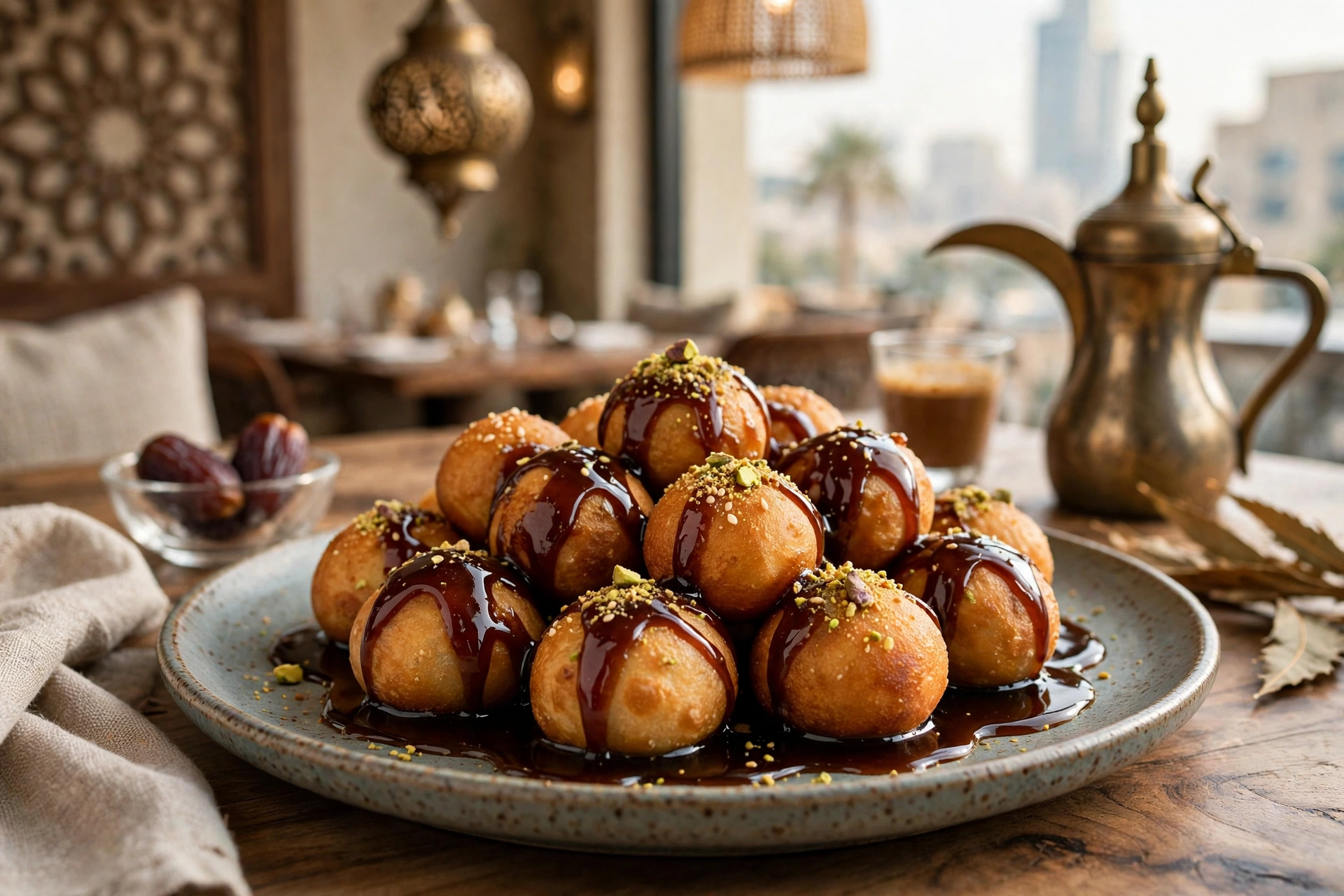
Luqaimat are small balls of dough deep-fried until crisp outside and soft inside, then drizzled with date syrup and scattered with sesame seeds. They are the sweet end of almost every Emirati meal, and they are everywhere during Ramadan, when vendors fry fresh batches all evening. At Al Fanar they cost AED 35. Eat them warm, straight from the fryer, and do not expect one plate to be enough. They are the single most popular dish in the Emirati food Dubai visitors take home in their memory.
Balaleet is the dish that surprises every first-timer in the Emirati food Dubai serves. Sweet saffron vermicelli noodles, flavoured with cardamom, cinnamon and rose water, are topped with a thin savoury omelette. Sweet and savoury in one bite, it is the classic Emirati breakfast, and it tastes far better than it sounds on paper. At Logma it costs AED 42. At Arabian Tea House, a balaleet breakfast in the courtyard is one of the best ways to start a morning in Old Dubai.
Thareed is a slow-cooked meat and vegetable stew served over torn pieces of flatbread, which soak up the broth until they turn soft. It is one of the oldest dishes in the Emirati food Dubai offers, a home dish that rarely makes tourist menus but appears at heritage restaurants and during Ramadan. If you see it on a menu, order it, because it shows the home-cooking side of Emirati food that the rice dishes do not.
Ghouzi, also called ouzi or khuzi, is a whole slow-roasted lamb or goat laid over spiced rice and showered with toasted almonds, pine nuts and raisins. It is the celebration dish of the Emirati food Dubai serves, cooked for weddings, Eid and National Day feasts, and it is almost always a sharing dish for a group rather than a single plate. Order it when you are eating with four or more people and want the table to feel like a feast.
Jasheed is dried, shredded fish, usually dried shark or kingfish, mixed with rice, onions and spices. It is the dish of the pearl divers, intensely savoury with an almost fermented depth, and it was built to give a day of energy at sea. It is an acquired taste, and it is one of the most distinctive dishes in the Emirati food Dubai has. Al Fanar serves it, and the Al Seef and Al Barsha branches, which focus on seafood, are the best places to try it.
Chebab are saffron and cardamom pancakes, served warm with date syrup or cream cheese. Khameer is a soft, slightly sweet leavened flatbread, sprinkled with sesame seeds and served with cheese, honey or date syrup. Both are breakfast breads, and both appear on almost every Emirati breakfast table in Dubai. At Logma, khameer with honey butter costs AED 32. They are the simplest dishes in the Emirati food Dubai offers, and the ones most visitors order again the next morning.
Camel meat is the traditional protein of the desert, leaner than beef, slightly sweet, and historically reserved for special occasions. In the Emirati food Dubai serves today, it appears as camel kebab, camel burgers and slow-cooked camel stew, mostly at heritage restaurants. Local House in Al Fahidi serves a camel meat kebab, and it is the most direct way to taste a food that fed Bedouin families for centuries. It is not on every menu, so ask before you go if it matters to you.
Two drinks frame every Emirati meal. Gahwa is Arabic coffee, pale, unsweetened and scented with cardamom, sometimes saffron, served in small handleless cups alongside fresh dates. It is a hospitality ritual, not a menu item, and it is poured continuously until the guest gently shakes the cup from side to side to signal they are done. Karak is the strong, sweet, spiced tea that fuels daily life in Dubai, made with black tea, milk, sugar and cardamom, and sold for around AED 1 to AED 2 from roadside cafeterias and for AED 22 at Logma. Gahwa is ceremony, karak is everyday life, and the Emirati food Dubai offers is incomplete without both.
There are only a handful of places serving the Emirati food Dubai is known for, and they fall into three groups: heritage restaurants in Old Dubai, modern Emirati restaurants in the new districts, and one desert dinner show. Pick by occasion, not by area, because the best Emirati food Dubai has is worth crossing the city for.
Al Fanar is the restaurant to visit if you can only visit one Emirati restaurant in Dubai. It opened in 2011 as the first restaurant dedicated to traditional Emirati food, and it now has five branches across Dubai, Abu Dhabi and Al Ain. The rooms recreate Dubai in the 1960s, with pearl diving equipment on the walls, antique radios, sepia photographs and fishing nets as ceiling features, and the kitchen serves the Emirati food Dubai visitors come to taste. The Festival City branch inside Dubai Festival City Mall is open daily from 9am to 10pm. The Al Seef branch on Dubai Creek, open from 1pm to 10.30pm, is part of the MICHELIN Guide Dubai 2026 restaurant selection. The Al Barsha Pond Park branch focuses on seafood. Order the harees at AED 58, the Machboos Al Laham at AED 72, the saloona at AED 62 and the luqaimat at AED 35, and expect around AED 100 to AED 180 per person for a full meal. Book ahead on weekends, and check Al Fanar’s own site for the current branch hours, because they change on public holidays and during Ramadan.
Al Khayma sits in the Al Fahidi Historical Neighbourhood, in a traditional Emirati home with a courtyard and a wind-tower facade, and it is one of the most atmospheric places to eat Emirati food Dubai has. It holds a MICHELIN Guide Bib Gourmand, which marks it out for quality and value, and it is a strong choice for an Emirati breakfast or an evening meal. The signature dishes are the Al Khayma mix grill, meat machboos, saffron rice and umm ali for dessert. Hours are listed as daily from 8am to 11pm, though some listings show split sittings, so call ahead at peak times. Expect around AED 150 to AED 300 per person, which makes it the priciest heritage option in this guide, and book ahead for the courtyard tables.
Arabian Tea House is the most relaxed place to eat Emirati food Dubai offers, and the best for a slow breakfast. It sits in a period home in Al Fahidi, with a skylight-roofed courtyard full of plants and turquoise and white furniture, and it serves home-style Emirati and Arabic comfort food all day. The Emirati breakfast tray, the balaleet, the machboos, the harees and the luqaimat are the dishes to order, and the tea and coffee culture is the point of the place as much as the food. Hours are daily from 7am to 11pm, and most mains sit in the AED 60 to AED 80 range, with breakfast items lower. It is also the best place in this guide to linger over gahwa and dates before starting a day in Old Dubai.
Logma is the contemporary face of Emirati food Dubai has, and the restaurant young Emiratis choose when they take friends from abroad for lunch. It takes traditional Emirati flavours and reworks them into a modern cafe format, with branches at Boxpark, City Walk, The Dubai Mall and JBR, open daily from 8am to 10pm. The balaleet at AED 42 is the dish that converts first-timers to Emirati breakfast food. The khameer with honey butter is AED 32, the chai karak is AED 22, and the chicken machboos is AED 68. The weekend brunch, Emirati dishes served family-style with unlimited karak, is one of the best casual dining experiences in the city. Expect AED 80 to AED 150 per person, and no booking is needed for most visits.
Gerbou is Dubai’s most prominent modern Emirati restaurant, and the one to book for a special occasion. It sits in a restored 1987 villa in Nad Al Sheba 1, owned by Tashkeel, an art and design organisation, and the room is as much a part of the experience as the food, with ghaf wood furniture, camel leather sofas and an underground pit for cooking. The menu reworks the Emirati food Dubai grew up with, using farm-to-table ingredients: chicken machboos, mezze boards, date salad, kunafa prawns and a fwala tray, the Emirati high tea. Hours are daily from 7am to 11pm, and the official price range is AED 100 to AED 200 per person, with a three-course meal running from around AED 120 to AED 465 depending on the dishes. The chicken machboos is listed at AED 160. Book ahead, and check Gerbou’s own site for the current menu, because the kitchen changes it with the seasons.
Seven Sands sits on The Beach at JBR, with a sea view, and it is the Emirati restaurant to choose when the setting matters as much as the food. It is owned by Dubai World Trade Centre and serves the Emirati food Dubai draws from all seven emirates, with signatures including veal harees, king fish machboos, lamb okra and shark sambousa. It is best known for its cultural Iftar during Ramadan, when a cultural talk on Emirati traditions runs alongside the meal. Prices sit in the mid to high range, and the Iftar menu has been listed at AED 249 per person in recent years, so confirm the current price before booking. It is a good pick for a first Emirati dinner with a view, and for families, because the beach setting keeps children happy.
Local House is a cheerful, culture-filled restaurant in the Al Fahidi Historical Neighbourhood, and it is the best place in this guide to try camel meat. The camel meat kebab is the signature, alongside chicken and mutton mandi, machboos and samak biryani. Hours are daily from 8am to 11pm, and mains typically sit in the AED 55 to AED 85 range. It is casual, social-media friendly and easy to walk into, which makes it a good second stop for the Emirati food Dubai offers on the same Al Fahidi walk.
Al Bait Al Qadeem is the budget pick among the Emirati food Dubai offers, and the most old-Dubai of all the restaurants in this guide. It sits in Al Ras in Deira, in a heritage-rich building dating back to 1909, and it serves simple Emirati and Arabic food with no frills. The signature dishes are chicken, meat and fish majboos, jeshid made from minced shark, fried fish Emirati-style and the Emirati platter. Hours are daily from around 9am to 9pm, and most mains sit in the AED 40 to AED 70 range. It is the place to go when you want authentic Emirati food at local prices, and it pairs well with a walk through Deira’s souks.
SMAT is a relaxed all-day resto-cafe serving the Emirati food Dubai is known for, in Building 10 of Dubai Design District, and it is the easiest Emirati restaurant in Dubai to drop into without a plan. It serves traditional Emirati-style biryani, mixed grills, Arabic breakfast items, coffee and desserts, with a mission to celebrate Emirati identity in a creative district. Hours are daily from 7.30am to 11.30pm, and prices sit in the casual to mid-range bracket. It is a good pick if you are already in d3 for the design scene and want an Emirati lunch without crossing town.
Ana is the modern restaurant for the Emirati food Dubai offers inside The Dubai Mall, on the first floor near the waterfall area, and it is the most convenient Emirati meal in the city for anyone already shopping or sightseeing in Downtown. The Emirati platter, with foul, halloumi, labneh, hummus, harees and vegetables, is the dish to order, alongside mbahar chicken or lamb, harees and khameer. Hours are daily from 10am to midnight, and until 1am on Friday and Saturday. Most mains sit in the AED 45 to AED 90 range, with platters around AED 59 to AED 85. It is not the most atmospheric Emirati restaurant in Dubai, but it is the easiest one to reach.
Al Hadheerah is not a restaurant in the usual sense, and it is the most spectacular way to eat Emirati food Dubai offers. It is an open-air Emirati village restaurant inside Bab Al Shams Desert Resort, roughly 45 minutes from the city on Al Qudra Road, where dinner comes with live oud music, falconry displays, camel rides, henna artists and a traditional food village around a central stage. The food is a lavish buffet of Emirati classics, including several machboos varieties, harees, whole roasted lamb, Emirati breads and a dessert spread of luqaimat and umm ali. Dinner is evenings only, and the buffet has been listed at AED 350 per person, with children under six free. It is worth the trip for a special occasion or a first night in Dubai, and it needs booking well ahead.
The food is only half of the Emirati food Dubai experience. The other half is how it is served, and getting the etiquette right costs nothing and earns a great deal.
Gahwa comes first. Arabic coffee is served in a dallah, a traditional pot, and poured into small handleless cups called finjan. It is pale, unsweetened and scented with cardamom, sometimes saffron, and it is always served with fresh dates. The dates are not a garnish. They are the sweetener, eaten between sips, and the pairing is one of the oldest hospitality rituals in the Gulf. Accepting gahwa and dates, even if you have just eaten, honours your host. Refusing them can read as a refusal of hospitality itself.
The rule for finishing is simple. Your host will keep pouring until you signal you are done, so gently tilt or shake the small cup from side to side when you have had enough. Do not put the cup down full and walk away, and do not ask for a large mug, because the small cup and the constant refilling are the point. The coffee is poured with the right hand, and you should accept it with the right hand too.
Meals are served communally, from shared platters placed in the centre of the table, and it is customary to eat with the right hand. At formal gatherings there is traditionally no alcohol, and halal dietary requirements are universal across the Emirati food Dubai serves, so there is nothing to ask about on that front. Dress modestly at heritage restaurants, especially in Al Fahidi and at cultural meals, and allow the meal to unfold at its natural pace. Emirati hospitality is generous by design, and the food keeps coming until you cannot eat another bite. That is not a mistake. It is the point.
Emirati food reaches its peak during Ramadan, and the holy month changes how and when the Emirati food Dubai offers is eaten. Ramadan 2027 is expected to start around 8 February 2027, subject to moon sighting, and it runs for about a month. During the day, most restaurants are quieter and some heritage cafes adjust their hours. In the evening, the city comes alive.
Iftar, the meal that breaks the fast at sunset, starts with dates and laban, a buttermilk drink, followed by harees, soups, jareesh and luqaimat. Many mosques and community organisations offer free Iftar meals to all comers, regardless of religion, and visitors are welcome to take part respectfully. Hotel Iftar buffets and heritage restaurants run special Iftar menus, and Al Fanar stays open late during Ramadan. Suhoor, the pre-dawn meal, is built on balaleet, khameer, eggs, dates and Arabic coffee.
Two practical rules apply to visitors during Ramadan. First, eat and drink discreetly in public during fasting hours, and avoid eating in front of people who are fasting. Second, book Iftar tables days ahead, because the popular Emirati restaurants fill up fast, especially on weekends. The Iftar experience, with its dates, harees and luqaimat, is the single best time of year to taste the Emirati food Dubai is proudest of.
One honest distinction matters more than any other in this guide to the Emirati food Dubai serves. Shawarma, hummus, tabbouleh, manakish and mixed grill are Levantine and Lebanese dishes, not Emirati ones. They are everywhere in Dubai, they are delicious, and they are not Emirati food. Genuine Emirati food is a Gulf cuisine, built on rice, dates, dried fish, slow-cooked meat and warm spices, shaped by Bedouin and pearl-diving history and by trade with Persia, India and East Africa.
The confusion is understandable, because many menus in Dubai mix the two. A restaurant can serve excellent hummus and still not be an Emirati restaurant. The test is simple: if the menu leads with machboos, harees, thareed, jasheed and luqaimat, it is Emirati. If it leads with mezze, shawarma and mixed grill, it is Levantine, and it may still be worth eating, but it is not the food this guide is about. The Emirati food Dubai offers is quieter, slower and harder to find than the Levantine food, and that is exactly why it is worth seeking out.

Start with the occasion, not the restaurant, when you pick from the Emirati food Dubai offers. For a first taste, go to Al Fanar at Festival City and order harees, machboos and luqaimat. It is the broadest introduction, and the 1960s setting gives the food its context. For a breakfast, go to Arabian Tea House in Al Fahidi and order balaleet, khameer and gahwa in the courtyard. For a modern take, go to Logma and order the balaleet and karak, or to Gerbou for a special occasion dinner. For a budget meal, go to Al Bait Al Qadeem in Deira. For a desert evening, book Al Hadheerah.
Then check three practical things before you pick from the Emirati food Dubai has in this guide. First, your budget. A heritage cafe breakfast costs AED 25 to AED 45 per person, a proper lunch costs AED 60 to AED 100, a full dinner costs AED 100 to AED 200, and the desert show costs around AED 350. Second, your group. Emirati food is made for sharing, so come with at least two people and order a spread rather than a single plate each. Third, your timing. Breakfast is best at Arabian Tea House and Logma, lunch is the main meal of the Emirati day, and Ramadan evenings are the best time of year for harees and luqaimat.
If you are building a day around Emirati food, pair it with the heritage around it. The Al Fahidi Historical Neighbourhood holds Arabian Tea House, Al Khayma and Local House within a few minutes walk, and our Meena Bazaar guide covers the food streets across the Creek in Bur Dubai. For a South Indian breakfast on another morning, our best breakfast places in Dubai guide has more early-morning options. And if you want to understand the culture behind the food, the Sheikh Mohammed Centre for Cultural Understanding runs cultural meals in Al Fahidi, near the mosque tours covered in our Jumeirah Mosque guide. Our Dubai travel guide helps you plan the rest of the trip around the meal.
Machboos is widely considered the national dish of the UAE. It is a fragrant one-pot rice dish cooked with lamb, chicken or seafood, with saffron, dried black limes, cardamom and a spice blend called bezar. Every Emirati family has its own recipe, passed down through generations, and it is the first dish to order from the Emirati food Dubai offers.
Emirati food is spiced but not typically spicy-hot in the way South Asian food can be. The spice profile leans towards warming spices, cardamom, saffron, cinnamon and dried lime, rather than chilli heat. Most visitors with a low spice tolerance enjoy the Emirati food Dubai serves without discomfort, and the sweet dishes like luqaimat and balaleet are not spicy at all.
Al Fanar is the best first stop for the Emirati food Dubai offers, with its full heritage menu and 1960s setting. Arabian Tea House in Al Fahidi is the best for breakfast and coffee culture. Logma is the best modern Emirati cafe. Gerbou is the best for a special occasion. If you can only visit one, visit Al Fanar at Festival City or Al Seef.
The Emirati food Dubai serves costs from around AED 25 to AED 45 per person for a breakfast at a heritage cafe, around AED 60 to AED 100 for a lunch, and around AED 100 to AED 180 for a full dinner at Al Fanar. The desert dinner show at Al Hadheerah costs around AED 350 per person. A single dish like harees costs AED 58 and machboos costs AED 72 at Al Fanar.
Arabic coffee, called gahwa, is a pale, unsweetened coffee scented with cardamom and sometimes saffron, served in small handleless cups alongside fresh dates. It is a hospitality ritual in the Emirati food Dubai offers, not a caffeine fix. Accept the cup with your right hand, drink it with dates, and gently shake the cup from side to side when you have had enough, so your host stops pouring.
Yes, and Ramadan is the best time of year for the Emirati food Dubai serves. Iftar, the sunset meal that breaks the fast, centres on dates, harees, soups and luqaimat, and many mosques offer free Iftar meals to all comers. Book Iftar tables days ahead, eat discreetly in public during fasting hours, and try the heritage restaurants after sunset, when the city comes alive.
This is a researched guide to the Emirati food Dubai offers, not a first-hand visit report. Facts were checked against restaurant and official pages and current listings on 5 November 2026. Al Fanar’s branches, hours, MICHELIN Guide 2026 selection for Al Seef and 2011 opening come from the restaurant’s own site, alfanarrestaurant.com. Gerbou’s hours, price range, address and 2025 launch come from the restaurant’s own site, gerbou.com, with dish prices from The National’s April 2025 review. Al Khayma, Arabian Tea House, Local House, Al Bait Al Qadeem, SMAT, Ana and Seven Sands details come from current Dubai food guides checked the same day. Dish descriptions and prices for machboos, harees, luqaimat and balaleet come from current Dubai food guides and the Dubai government food page at dubai.ae. Ramadan 2027 is expected to start around 8 February 2027, subject to moon sighting, and is a projection, not a confirmed date. Hours and prices change often, so confirm with the restaurant on the day you go.
Written by
Daniel
Daniel is the travel writer behind Go Dubai Now, covering Dubai's attractions, parks, restaurants and practical travel topics. Every guide is researched against official sources — government portals, operator websites and current local listings — and updated regularly so timings, prices and rules stay accurate. His goal is simple: answer the exact questions travelers ask before they go, with no fluff and no outdated information.
Handpicked guides, itineraries and money-saving tips for your Dubai holiday — all in one place.