 Daniel
•
June 19, 2026
•
17 min read
•
No comments
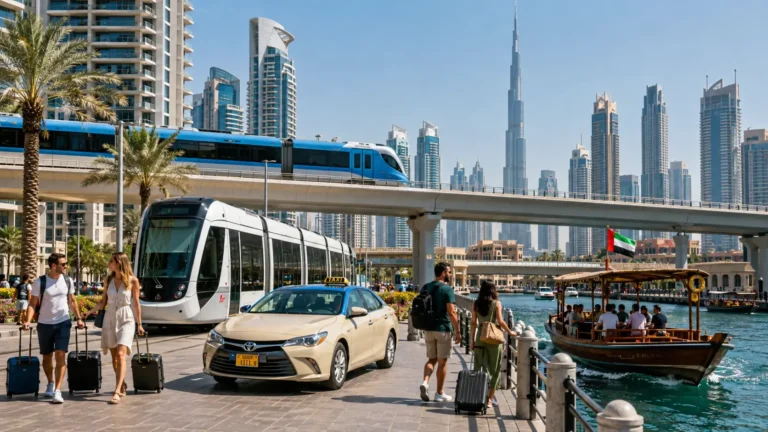
Figuring out Dubai public transport before you land saves you money, time and a fair amount of confusion at the airport. The network is run mainly by the Roads and Transport Authority (RTA) and links the city through the Dubai Metro, Dubai Tram, public buses, taxis and marine transport — all working as one connected Dubai public transport system rather than a set of separate services.
For most Metro, Tram and standard bus journeys across Dubai public transport, the single most important thing to understand is the nol card: a reusable smart card (or limited paper ticket) that pays for almost everything on rails and wheels. Fares are calculated by zones, services follow published operating hours, and RTA’s S’hail app plans routes across the whole Dubai public transport network in real time.
This guide explains how Dubai public transport actually works in practice nol cards and fares, Metro lines, the Tram, buses, taxis, airport connections, marine transport, accessibility and the official apps plus an honest split between what is operating today and what is still under construction. If your bigger question is whether the Metro, a taxi, a bus or a rental car suits your trip best, see our separate How to Travel in Dubai as a Tourist guide; this page is the detailed Dubai public transport reference.
| Mode | Main payment | Key point |
|---|---|---|
| Dubai Metro | nol card | Red and Green Lines; zone-based fares |
| Dubai Tram | nol card | Serves Marina, JBR and the Al Sufouh corridor |
| Dubai Bus | nol card / valid ticket | Wide network; routes and schedules vary |
| RTA Taxi | Metered fare | Street hail or authorised app booking |
| Traditional Creek Abra | Cash (AED 1 routes) | Separate marine fare rules |
| Other RTA Marine | Varies by route | Ferry, Water Taxi and modern abras |
| Palm Monorail | Separate system | Temporarily suspended at time of checking |
The Metro, Tram and buses sit inside one integrated nol fare system, while taxis and some marine services price journeys differently. Understanding that split is the foundation of using Dubai public transport well.
Dubai public transport divides the emirate into seven fare zones. When you ride the Metro, Tram or a standard RTA bus, what you pay depends on how many zones your journey crosses — not on how many stops you pass. A short hop inside one zone costs the same whether it is two stops or six.
The basic routine for any Dubai public transport journey is:
RTA also rewards combined journeys: leave the Metro and board a bus within 30 minutes and the two legs count as one trip, with up to three transfers allowed under the current rules. That makes Dubai public transport genuinely multimodal — one card, one fare calculation, several vehicles.
The nol card is the key that unlocks Dubai public transport, and RTA sells several versions. Most short-term visitors only need to choose between three: Silver, Gold and the Red Ticket.
A Silver nol card currently costs AED 25, which includes AED 19 of travel balance. It charges the standard Dubai public transport fare scale and is the sensible reusable choice if you will ride the Metro, Tram or buses more than a couple of times.
The Gold card costs the same — AED 25 including AED 19 balance — but unlocks the plusher Gold Class cabins on Metro and Tram. Journeys are charged at the higher Gold fare, so only buy it if you actually want Gold Class seating on Dubai public transport.
The Red Ticket is a disposable paper ticket costing AED 2 before the journey fare. RTA lets you reload it for up to 10 journeys or five daily passes. It works across Dubai public transport’s Metro, Tram and buses, but it is the least flexible option — fine for a day or two, frustrating for a week.
Staying several days and riding daily? Buy Silver it is the default visitor card for Dubai public transport for good reason. Want premium cabins? Go Gold. In town for barely 48 hours with two Metro rides planned? The Red Ticket will do.
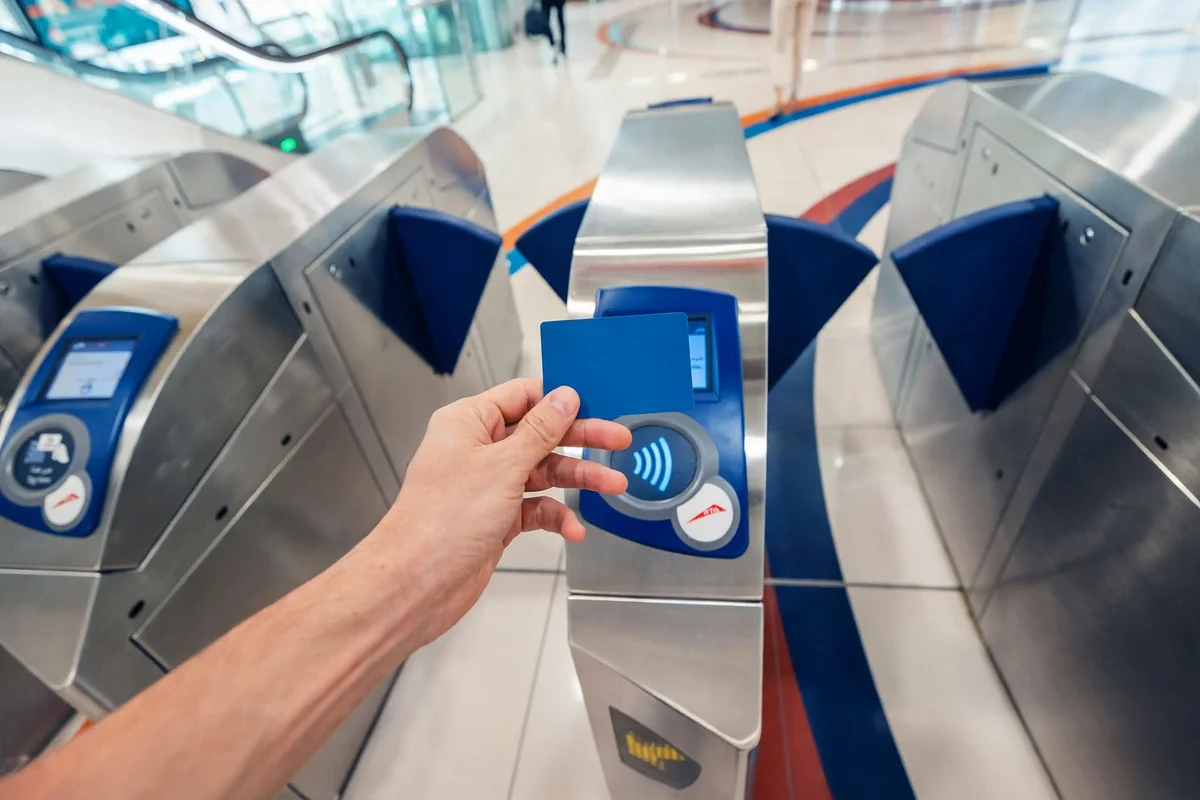
Dubai public transport fares are refreshingly simple once you know the zone logic. These are RTA’s current published fares.
| Journey | Fare |
|---|---|
| Within 1 zone | AED 3 |
| 2 adjacent zones | AED 5 |
| More than 2 zones | AED 7.50 |
| Journey | Fare |
|---|---|
| Within 1 zone | AED 6 |
| 2 adjacent zones | AED 10 |
| More than 2 zones | AED 15 |
| Journey | Fare |
|---|---|
| Within 1 zone | AED 4 |
| 2 adjacent zones | AED 6 |
| More than 2 zones | AED 8.50 |
Ignore any old blog claiming every Silver journey is a fixed percentage cheaper than other tickets — the real difference on Dubai public transport depends on the zones crossed and the ticket type, exactly as the tables above show.
RTA currently requires a minimum balance of AED 7.50 on your card to check in to Dubai public transport services such as the Metro. Keep a little more than that loaded if you plan a long multi-zone journey or several rides before your next top-up — nothing ruins a morning like a rejected tap at the gate.
Do not confuse the minimum balance with the minimum top-up: you need at least AED 7.50 on the card to travel, while the smallest top-up RTA accepts is AED 20 (or AED 5 through the nol Pay app, according to RTA’s published materials).
Physical nol products for Dubai public transport are sold and topped up through Metro ticket-vending machines, Metro ticket offices, authorised RTA sales agents and RTA’s digital channels. Payment methods accepted at sales points include cash and credit/debit cards — which brings us to a common point of confusion.
For normal travel on Dubai public transport, have a valid nol product before you board: RTA states that cash is not accepted as a direct fare-payment method on its standard modes. You cannot hand the bus driver a banknote.
But cash is not useless in the system. It is still accepted at many ticket-sales and top-up points, and some marine services run their own cash rules (the AED 1 abra, for example, is cash only). The rule of thumb: cash buys the card, the card buys the journey.
RTA offers virtual nol functionality through the nol Pay app — but do not assume it works on your phone. As of RTA’s July 2026 service update, virtual nol cards can be bought and managed through nol Pay only on compatible Samsung and Huawei phones, with support also listed for the Huawei Watch 3 and Watch 3 Pro.
The nol Pay app itself may appear in other app stores, including Apple’s App Store, yet virtual-card compatibility is far narrower than app availability. Unless you have confirmed your device is supported, a physical Silver card remains the dependable way to pay across Dubai public transport.
Dubai public transport is midway through a major modernisation of the nol system. On 5 July 2026 RTA reported that 72% of its migration from card-based ticketing to account-based ticketing was complete, with the full programme scheduled to finish by the end of the first quarter of 2027.
The upgraded system is designed to eventually support account-linked nol cards, QR-code tickets, a new generation of nol cards, smartphone-wallet integration, bank-card fare payments, digital-wallet payments and automatic top-up. Exciting — but these are rollout features, not today’s reality. Do not board the Metro assuming every gate already accepts your bank card; for now, travel on Dubai public transport with the currently supported nol products.
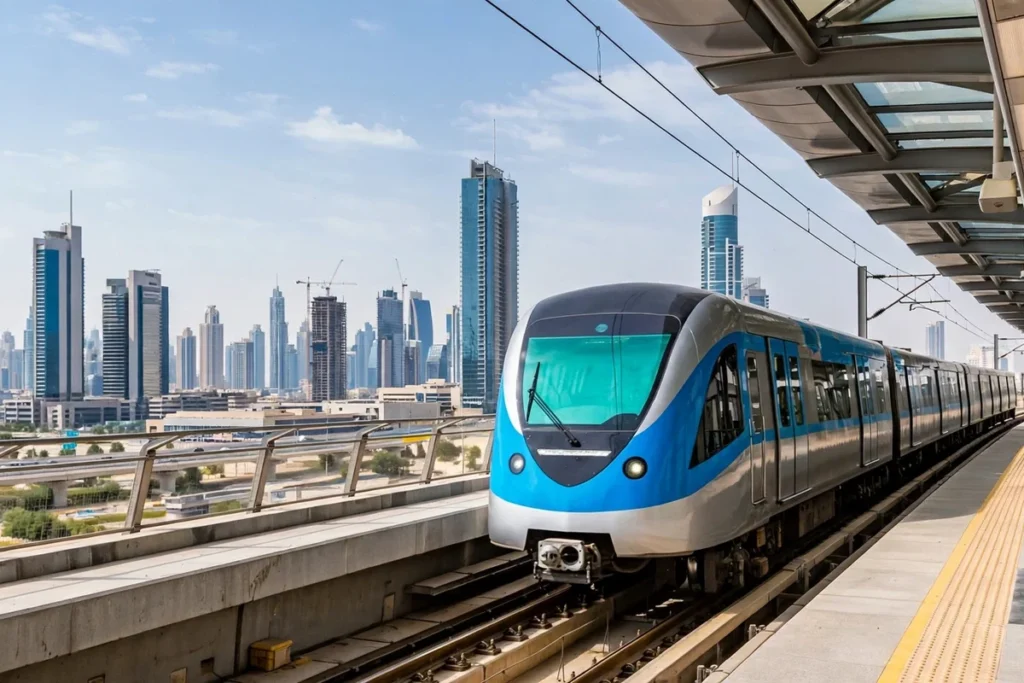
The driverless Dubai Metro is the backbone of Dubai public transport and currently runs two principal lines. The Red Line sweeps across modern Dubai, connecting Dubai International Airport, Downtown, Business Bay, Dubai Marina and the Expo area. The Green Line serves the historic Deira and Bur Dubai districts on the Creek side.
RTA currently lists the Red Line as operating from Centrepoint to Expo 2020 / Life Pharmacy. Note the southern branch: not every Red Line train serves the same final stop, so check the destination board before boarding rather than assuming.
The Green Line currently operates between e& (G11) and Creek (G30) — though station names and service patterns can change, so glance at the current RTA timetable on your travel day.
The two Metro lines interchange at Union and BurJuman — the two stations every Dubai public transport user should memorise first. For the Marina and JBR corridor, Metro-to-Tram interchanges sit at Sobha Realty and DMCC.
| Day | Regular Metro hours |
|---|---|
| Monday–Thursday | 5:00am – 12:00 midnight |
| Friday | 5:00am – 1:00am (next day) |
| Saturday | 5:00am – 12:00 midnight |
| Sunday | 8:00am – 12:00 midnight |
These are station opening hours, not guaranteed first- and last-train times from every platform — and RTA can extend hours for public holidays and major events. Travelling close to opening or closing time? Check live journey information first.
Dubai Metro trains carry standard cabins, Gold Class and designated Women & Children cabins. Gold Class needs the Gold fare; the Women & Children cabin has its own restrictions — follow the markings on platforms and trains rather than guessing where each cabin stops.
Each passenger may carry up to two suitcases: one large (up to 81 x 58 x 30 cm) and one small (up to 55 x 38 x 20 cm), kept in the designated luggage areas and clear of the doors. Handy to know when you ride Dubai public transport straight from DXB with your bags.
The Dubai Tram loops through the Marina, JBR and Al Sufouh corridor and plugs directly into the Metro network — a genuinely useful link in Dubai public transport if you are staying in that part of town. It runs on the nol system, but unlike the gated Metro you must remember to validate at the Tram stops themselves, both when boarding and when leaving.
| Day | Tram hours |
|---|---|
| Monday–Saturday | 6:00am – 1:00am (next day) |
| Sunday | 9:00am – 1:00am (next day) |
The Palm Monorail is not part of Dubai public transport’s RTA network — it is a separate system, and an important warning applies. The operator’s official website currently states that monorail service is temporarily suspended until further notice due to maintenance, a notice still live at the last check on 20 August 2026. Do not build a Palm Jumeirah journey around the Monorail until the operator confirms it has reopened.
Dubai’s RTA bus network is the quiet workhorse of Dubai public transport, feeding Metro stations and reaching neighbourhoods, commercial districts and destinations far beyond the rails. Standard bus travel sits inside the nol system: have a valid card or ticket before boarding and validate as required.
One caveat — bus routes and schedules change more often than the Metro timetable, so a static guide cannot usefully list them all. For your exact stop and date, use S’hail or RTA’s current timetable tools rather than a screenshot from last year.
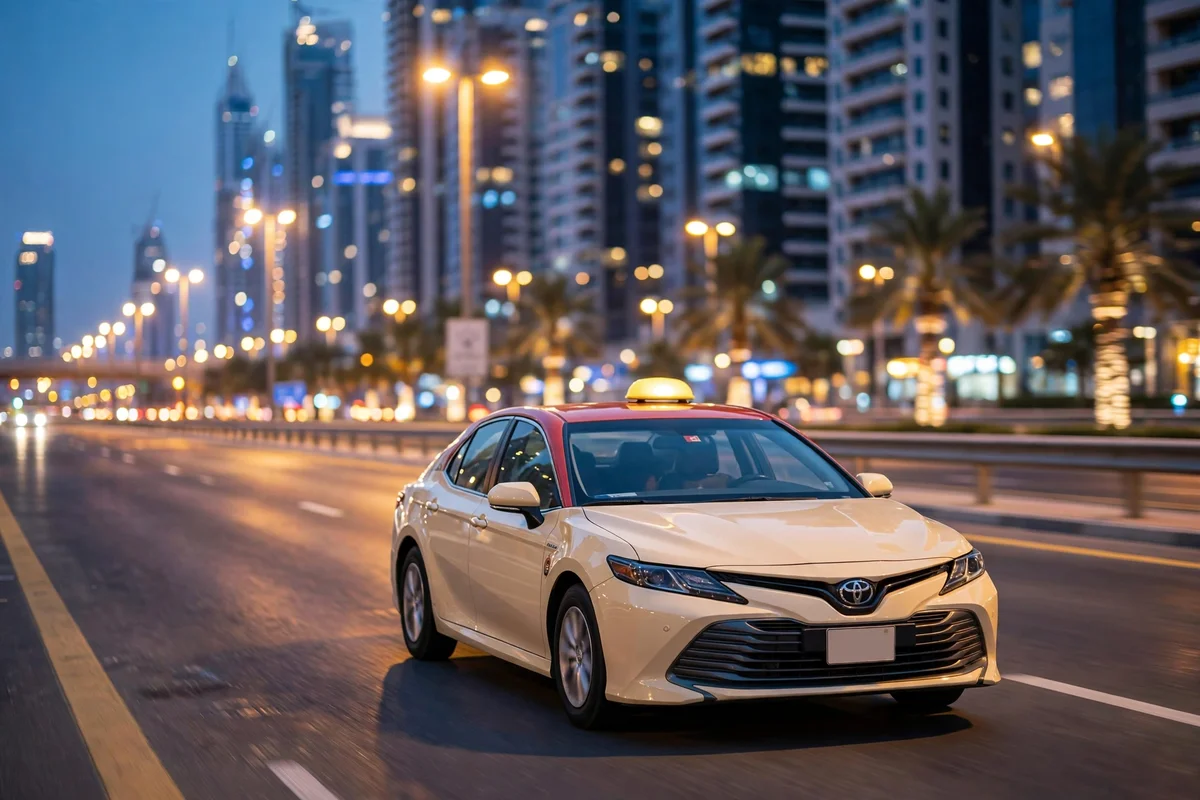
Taxis sit slightly apart from the rest of Dubai public transport: they run on metered fares, not the zone system. Two numbers matter on every trip — the starting fare shown when the meter begins, and the minimum trip fare, which means even the shortest ride cannot cost less than the published minimum.
For a regular taxi flagged down on the road, Dubai Taxi Company currently publishes a starting fare of AED 5 between 6:00am and 10:00pm and AED 5.50 overnight (10:00pm–6:00am), with a minimum trip fare of AED 12. Distance, waiting time, Salik tolls and other charges sit on top.
Book through an authorised app and the starting fare shifts with demand: generally AED 9 in standard periods, AED 13 at defined peak times and AED 10 overnight — with a minimum e-hail trip fare of AED 13. So that AED 9 flag-fall can never produce a sub-AED-13 journey.
Dubai Taxi Company’s dedicated airport tariff lists a AED 20 starting fare for a normal airport taxi and AED 25 for a van, plus distance. Do not confuse these with the AED 5/5.50 street-hail starting fare — airport pickups play by their own tariff.
Official RTA booking channels include S’hail and authorised partner apps — currently Careem/Hala, Bolt, Zed and Yango — alongside old-fashioned street hailing and taxi ranks. For payment, RTA supports cash, credit card, nol card and supported mobile or digital methods, though the exact mix can depend on the vehicle and how you booked.
Water is part of Dubai public transport too, and RTA’s marine network is more varied than most visitors expect: traditional abras, modern abras, the Dubai Ferry, Water Taxis and other scheduled connections, each with its own fares and payment rules.
Two traditional Creek crossings keep the legendary AED 1 fare, cash only, per passenger per journey: Bur Dubai Marine Station ↔ Deira Old Souq and Dubai Old Souq ↔ Al Sabkha. It is one of the great bargains in Dubai public transport — but do not assume every abra, ferry or water-taxi ride costs AED 1. Other routes charge different fares with different payment arrangements, so check before you board.

Terminals 1 and 3 connect directly to the Metro’s Red Line, making the train the fastest budget route into the city on Dubai public transport. Dubai Airports publishes the same regular Metro schedule as RTA (5am–midnight Monday–Thursday and Saturday, 5am–1am Friday, 8am–midnight Sunday), and nol cards and tickets are sold at the airport station facilities.
Terminal 2 is the exception: it has no Metro station of its own. Do not apply Terminal 1/3 advice to a Terminal 2 arrival — check S’hail for the current bus or taxi connection to your destination.
DWC has no Metro station inside the passenger terminal. Dubai Airports lists two RTA bus links: F55 (DWC ↔ Expo Metro Station) and N55 (DWC ↔ Ibn Battuta bus/Metro stations), both running at roughly 30-minute intervals. You will need a nol card — Dubai Airports specifically notes cash is not accepted as bus fare here. Airport routes change, so recheck S’hail on your travel date.
Dubai public transport includes accessibility features across Metro, Tram, buses and marine facilities for People of Determination — tactile guidance at stations, wheelchair-accessible ticket facilities, lifts, designated wheelchair spaces on trains, low-floor buses, accessible marine facilities and audio-visual passenger information. Concession travel may need a qualifying personalised nol product rather than an anonymous tourist card, so check eligibility before buying.
Children aged five and below travel free on Dubai public transport. RTA’s supervision rules say children under eight should not travel unaccompanied, ages eight to eleven need parental permission, and passengers twelve and above may travel alone under the applicable policy.
RTA’s main journey-planning app and the single most useful download for Dubai public transport: live routes, timetables, nol account access and taxi booking in one place. If you install one app, make it this one.
Focused on nol services — card management, top-ups and the device-limited virtual nol functions described above.
The broader official platform covering RTA’s full range of transport, traffic and vehicle services.
Dubai public transport runs on formal fare and conduct rules, and inspectors do check. The essentials: always carry a valid fare product, tap in and out correctly, sit in the right cabin, never enter Gold Class without the Gold fare, respect Women & Children cabin restrictions, keep luggage clear of doors, follow signage and staff instructions. RTA fines fare evasion and invalid-card use — but simply validating properly and following the posted rules keeps you clear of nearly every issue visitors face.
Dubai announces ambitious transport projects constantly, and blogs often write about them as if they already exist. Here is the honest split for Dubai public transport right now.
Real, but small: RTA began commercial autonomous-taxi operations in Umm Suqeim and Jumeirah in March 2026, with Apollo Go and WeRide vehicles bookable through supported platforms in those areas. Do not assume the whole city is covered.
RTA’s August 2026 update says commercial Air Taxi operations are being prepared for the end of 2026. Until RTA confirms passenger service has actually started, do not plan airport transfers around it.
A 30-kilometre, 14-station project reported at roughly 20% completion in May 2026, with opening scheduled for 9 September 2029. Not part of the Dubai public transport network you can ride today.
Officially approved in April 2026, with tendering during 2026, contract award in 2027 and a planned inauguration on 9 September 2032. Do not describe it as operating or opening in 2026.
Once the nol system, the seven zones and the transfer rules click, Dubai public transport is one of the easier big-city networks in the world to use. For the separate question of which option best fits your itinerary, budget or family, our How to Travel in Dubai as a Tourist guide compares the choices side by side — and RTA’s official site carries the definitive current timetables and fares.
AED 25, including AED 19 of travel balance — the standard visitor card for Dubai public transport.
On Silver nol: AED 3 within one zone, AED 5 across two adjacent zones, AED 7.50 across more than two zones.
AED 7.50 is currently required on the card to check in to Dubai public transport services such as the Metro.
Do not assume so. RTA currently supports virtual nol through nol Pay only on compatible Samsung and Huawei phones (plus specified Huawei watches) — compatibility is device-specific, not universal.
Regular hours: 5am–midnight Monday–Thursday, 5am–1am Friday, 5am–midnight Saturday, 8am–midnight Sunday.
Yes from DXB Terminals 1 and 3 on the Red Line. Terminal 2 has no Metro station.
At the last check the operator’s site still showed service temporarily suspended for maintenance — do not plan around it until reopening is confirmed.
No. RTA is preparing commercial operations for the end of 2026; it is not a bookable option yet.
Written by
Daniel
Daniel is the travel writer behind Go Dubai Now, covering Dubai's attractions, parks, restaurants and practical travel topics. Every guide is researched against official sources — government portals, operator websites and current local listings — and updated regularly so timings, prices and rules stay accurate. His goal is simple: answer the exact questions travelers ask before they go, with no fluff and no outdated information.
Handpicked guides, itineraries and money-saving tips for your Dubai holiday — all in one place.